Illusion of Control: Orientation Instead of Certainty

Illusion of Control: Orientation Instead of Certainty

Two hands hold an old steering wheel floating above a dark stone floor.
VideoATAS webinar

Illusion of Control:
Orientation Instead
of Certainty

Anyone who trades wishes for certainty. Trying to get it from the market creates stress: the brain works with predictions, and emotions can be read as feedback on them, not as mistakes. Preparation can be planned, and where certainty is missing, orientation can take its place.

Holding on feels like control. It does not steer the market.Image: TradeNeon

Key points first

A statistically tested system and risk management are the foundation, but they do not make the outcome of a single trade controllable. Preparation can be planned, while trading itself takes place in uncertainty, and anyone who demands certainty from the market easily comes under stress. Noticing emotions early, reading them as data and answering consciously in the space between stimulus and response gives orientation.

01

The video

Playing the video connects to YouTube. Watch on YouTube

Chapters in the video 22

Click a timestamp to start the video at that point.

Video: ATAS DeutschlandMore videos from TradeNeon on our YouTube channel.

02

Why control does not work in trading

Complexity arises faster than you might think: with just ten numbers, there are already 3.6 million possible orders. In trading, market behavior, your own setup, emotions and your form on the day interact. A system like that cannot be controlled in a linear way, with clear causes and effects.

This fits the image that the brain is not a blender. We often look for an instruction manual with buttons so that we are not angry but alert and calm. Anyone who treats themselves like an uncomplicated system should not be surprised when the result differs from what they hoped for.

According to the predictive mind model, the brain can be described as a prediction machine: it serves primarily to secure survival and constantly uses predictions for it. It reacts to deviations and draws on experiences, patterns and also bodily experiences. Behind this there is a second function: the brain wants to expand our world through learning, adaptation, curiosity and exploration.

03

Prediction error: when expectation and reality diverge

If reality does not match the expectation, this model speaks of a prediction errorA prediction error: reality does not match the brain's expectation. It is normal at first and drives learning and adaptation.. It triggers an inner excitation (arousalThe inner excitation a prediction error triggers. It often shows up as an emotional reaction.), often an emotional reaction. An emotion is thus a response to the difference between expectation and reality, and that is not a problem at first. The prediction error drives learning and adaptation. It becomes dangerous when we respond to it with stress.

When does the system tip over? When you do not know what you feel, or when you ignore and suppress the message from your body. “Emotions are helpers in fulfilling needs. When you feel an emotion, there is a reason for it,” says Marnie Aramruck. If an emotion is permanently overridden, it can end in overwhelm and loss of control. The normal cognitive prediction error then turns into an emotional conflict, and in trading that becomes a trap.

One example is fear of an exam the next day. The fear wants to create certainty, and its tactic can be to keep studying. Without fear, you might go into the exam less prepared. So a healthy fear has a task.

04

Stress, tunnel vision and priming

When fear is overridden, perception narrows, as in the Stone Age when a saber-toothed tiger appears: all the energy flows into safety. In trading, this changes the view of the market, and tunnel visionUnder stress, perception narrows. In trading, this changes the view of the market. arises. We then get certainty through thoughts that replace perception: “The market has to rise now” or “This trade has to work now”.

PrimingWhat you experienced beforehand, such as a losing trade, colors the next moment. adds to this: what you experienced beforehand, such as a losing trade, you carry into the next moment and it colors it. Anyone who knows this will recognize it more easily in the next trading hours.

A chart example: on the 5-second chart, a heatmap with Level of Interest shows a bull zone, the idea is a long trade at an important level, with an entry after a small sideways phase. Instead, the market reacts immediately with a V-shaped reversal, without a range. The setup does not form, you do not get into the trade and, in the unfavorable case, you jump in afterward. After the larger move, doubts arise about whether you should have traded after all. That is how the prediction error shows up in trading: the reaction is the answer to a prediction that was held on to. What matters is the change of perspective. Anyone who knows that the brain is complex and the market uncertain, and does not demand certainty from the market, deals with such moments differently.

Heatmap on a 5-second chart with a green zone at the bottom: price falls into the zone and immediately turns up in a V-shaped move.
Chart example from the webinar: the direction was right, but the entry condition never occurred. From minute 25. Image: TradeNeon
05

The illusion of control and what can really be planned

There is structure in trading, but no certainty about how a trade will turn out. The basis is a statistically founded system with backtesting and forward testing, as well as risk management with clear position sizes, stops, profit targets and predefined entries and exits. That says nothing about the individual outcome, but it gives orientation and limits risk. Planning and execution are two different things.

What cannot be controlled is whether a trade turns out positive, how the market reacts and the spontaneous emotional reaction, at least if you are not prepared. Emotions cannot really be controlled, but their intensity can be regulated.

Three illusions of control stand out: the attempt to suppress emotions instead of navigating them, busyness mistaken for self-efficacyThe experience of being able to make something happen yourself. To be set apart from blind busyness, which is only a reaction., and the false sense of security with which people avoid uncertainty. Typical attempts at control belong here: pushing nervousness away, staring at the running trade although an alert can be set at a price level, exiting early, adjusting or leaving it open longer in the hope that the market still turns. These are reactions to fear and not to the system. The thought “this trade has to work now” is also such an attempt, because in trading there are only probabilities and no certainties.

06

Between stimulus and response there is a space

When control falls away, you need neither a new tool nor new rules, but orientation in the midst of uncertainty. System, risk management and rule set must be in place. What then decides is attitude.

The core image: between stimulus and response there is a space, and that is where your freedom begins. The stimulus is, for example, that the market runs through without the expected sideways phase. The reaction can be jumping in afterward or the later agonizing. In the space in between, four things matter: perception, acceptance, empathy and adaptation. Perception means recognizing what is really happening and whether you currently have tunnel vision. Acceptance means that the idea can be right while the setup is not. Adaptation concerns the view of the market and the emotional reaction. Empathy means compassion with yourself, that is, meeting yourself with goodwill and not condemning yourself. All of this can be trained, and it helps decide whether the mouse click at the end is a resilient or a headless reaction.

You hold this space not with control but with a connection to yourself, called self-anchoring. “This is where MindCrafting begins: not control but orientation. That is the attitude we teach,” says Marnie Aramruck.

07

Emotions as a navigation system and source of data

In the model, the brain implements its strategy through emotions, as feedback loops. They show whether a prediction was fulfilled. If it was, pleasant emotions such as joy or gratitude arise. If it was not, for example with fear, the question arises what you can do to gain more certainty. If the prediction error tips into stress, the data have not been read.

Emotion and feeling should be told apart: emotions run unconsciously and translate into bodily sensations. The body is the bridge between mind and emotion. Heartbeat, stomach, muscle tone or sweat can serve as an early warning system, and everyone reacts to them differently.

The widespread maxim “Trade like a machine” has a counterpart in “Trade like MindCrafter”. “I find it really terrible that it is always said: trade like a machine. You are not a robot, and the market is not a robot either. Emotions are not mistakes, they are data,” says Marnie Aramruck. Anyone who does not allow certain emotions cuts themselves off from their energy, from their feedback as a navigation system and from possible coping strategies. One example is anger, whose bright side is self-efficacy. Anyone who does not allow it may find it harder to experience themselves as self-effective and may feel less pride. Anyone who suppresses emotions over a long time may find that pressure builds up, as in a pressure cooker.

Emotional flexibility means being able to switch between states, like babies who are screaming one moment and laughing the next. Adults have often unlearned this. An everyday example: anyone who gets angry in a traffic jam on the way to a meeting can shift their focus or, if it keeps happening, change the strategy and take the train, for example.

08

Training the space: before, during and after the trade

A few questions are worth asking beforehand: what do you currently do to calm yourself, and does it really help? A stress ball during the session can make sense, because emotions do not immediately mean a call to action. If it does not help, a breathing exercise could work. Also: where in your life outside trading are you good at navigating instead of controlling, and what can you transfer from it? Small things are a good way to practice impulse control, such as rules for social media and messengers.

The space can be created at three points in time. Before the trade, you create awareness and do not go into the session too stressed. During trading, you recognize your early warning systems: which emotions come up for you, which block you, when do your hands get sweaty, what calms you? After trading, it is not about judging but about reflecting. Which strategies fit is individual: “It would be totally fatal to say: what works for me works for you. That does not work,” says Marnie Aramruck.

When the space is hard to find, there are three paths. First, one-to-one coaching to resolve blocks, where it is possible to distinguish whether the block lies on the cognitive, emotional or action level. Second, a resilience training that trains exactly these strategies. Third, an open, honest community in which the point is not the biggest trade but questions such as: how do I feel right now, what went wrong, have I tested my system, where is the lever?

09

What you can take away from the webinar

  • Control exists in planning, not in trading itself. System, risk management and rules are the structure. The individual outcome and the market's reaction remain uncertain.
  • Emotions are data. An emotion shows a difference between expectation and reality. Anyone who notices it early can regulate it instead of being overrun by it.
  • The mistake lies in how you deal with it, not in the feeling. Tunnel vision, priming and the thought “it has to work now” color perception.
  • Between stimulus and response there is a space. Perception, acceptance, empathy with yourself and adaptation can be trained, before, during and after the trade.

“Trading does not begin with control, but with the ability to guide yourself through uncertainty. Because between what you plan and what you do lies not weakness but a world that wants to be navigated.”

Marnie Aramruck in the closing words of the webinar (translated from German)
10

About the webinar

The webinar ran on January 15, 2026 on the YouTube channel of ATAS Deutschland, with questions and answers in the chat. It is held in German; on YouTube, you can switch on YouTube's subtitle translation. ATAS is a trading platform for order flow analysis. Marnie Aramruck is the founder of TradeNeon and works as a master emotion coach and resilience trainer on trading psychology. You can find all appearances of Marnie and Oliver on our guest appearances page.

TradeNeon · Trading psychology
How do you deal with uncertainty in trading?
In the MindCrafter programme, you train to stay calm and clear under pressure, structured, practical for everyday life and made for traders. The programme is currently offered in German.
Learn more (German)
Frequently asked questions
What does illusion of control mean in trading?

This means the attempt to create a certainty in trading that the market cannot give. Planning, system and risk management can be controlled, but the outcome of a single trade, the market's reaction and the spontaneous emotional reaction cannot.

So do I not need a system and rules?

You do. A statistically founded system, risk management with clear position sizes, stops and targets, and predefined entries and exits are the basis. This structure gives orientation and limits risk, but it does not give certainty for the individual outcome. On top of that, you need an attitude for the moment of uncertainty.

Are emotions a mistake in trading?

No. Emotions can be understood as a navigation system and source of data. They show that expectation and reality do not match. It becomes a problem when you ignore or suppress them and then follow them impulsively.

What can I do if I act impulsively under pressure?

One approach is to train the space between stimulus and response: create awareness before the trade, recognize early warning signs during trading and reflect instead of judging after the trade. Which strategies suit you is individual. Possible support includes one-to-one coaching, a resilience training and an open community.

Marnie Aramruck
Marnie Aramruck
Founder & Head of Brand & Psychology · TradeNeon
Marnie Aramruck came to trading by an unusual route: ten years self-employed in event management, marketing and design, before turning to the psychology behind decisions. As a master emotion coach and resilience trainer, she now works on a single question: what traders need in order to stay calm and clear even under pressure. Her subject is not the chart, but the person in front of it.

Day Trading and Gut Feeling: What Experience Does

Day Trading and Gut Feeling: What Experience Does

Two hands hold an old brass compass at stomach height, in front of an open, well-worn logbook full of bookmarks.
VideoATAS webinar

Day Trading and Gut Feeling:
What Experience Does

“Trade like a machine” is a well-known motto, but anyone who tries to force it through at all costs does not always get the result they want. Gut feeling in trading can mean two very different things: the belief that you can read a chart after a few weeks, and the experience a trader builds at the market over years. The article sorts out what experience delivers, where mechanical strategies reach their limits and how a healthy gut feeling develops.

A feeling built on many hours in the market is something other than guessing.Image: TradeNeon

Key points first

There are two kinds of gut feeling: the belief that you can read a chart after a few weeks, which is best avoided in trading, and experience from many hours at the market, which matters especially in discretionary day trading. Discretionary trading combines market understanding and experience, while mechanical trading follows fixed rules and needs upkeep because its advantage can wear off. A healthy gut feeling develops over years, with time at the market and without the pressure of having to live off trading.

01

The video

Playing the video connects to YouTube. Watch on YouTube

Chapters in the video 18

Click a timestamp to start the video at that point.

Video: ATAS DeutschlandMore videos from TradeNeon on our YouTube channel.

02

Two kinds of gut feeling

“Trade like a machine” is a well-known motto in forums and trading channels. The thought behind it: anyone who wants to succeed in trading has to act without emotion. But we are not machines, and anyone who tries to force that motto through at all costs does not always get the result they want.

Gut feeling is not the same as gut feeling. The first kind is the belief that you can read a chart: anyone who watches a chart for a few weeks quickly comes to think they can read it and know what price will do next. That is true for many, as conversations with people interested in the training programme show. With investment decisions, too, you often hear that someone decided by gut feeling because the price had fallen and the stock therefore seemed cheap.

A falling price alone, however, does not prove that a stock is cheaply valued. Prices also fall because of market moves or political events, not only because of the company itself. Concluding “price fell, so it is cheap” without fundamental analysis is dangerous. This form of gut feeling is something to avoid at all costs in trading. It becomes especially tricky when it gets lucky at the start, because it can take a long time before a single trade goes clearly negative.

03

Pattern recognition in day trading: an example on the chart

The other kind of gut feeling is experience from many hours at the market and very useful in day trading, in some disciplines even almost necessary. It goes by the name pattern recognitionRecognizing recurring patterns in the price action of a market. Oliver calls it pattern recognition.. It does not mean only drawing flags, triangles or head-and-shoulders formations; that is just one part of it. It is mainly about patterns in the price action of the market you have chosen, such as a setupA trading situation a trader waits for deliberately, such as a stop run at a level. you look for again and again.

An example on the chart: with levels from the morning analysis, the trader waits for the market to run to a level and show exhaustion or a stop runPrice moves through a zone where many stop orders sit and triggers them. there. The market comes down to the level and probably forms a small stop run. This cannot be verified on the chart, since no MBO data were available. Even MBO data would show individual orders only anonymously, not who is trading.

5-second chart of the S&P 500 E-mini future (ES) with an order book heatmap. A horizontal band shaded in red around 5,759 to 5,761 marks the level; the price moves around this band and drops below it several times.
The band shaded in red is the level. In Oliver's reading, the first small dip below the level is a possible small stop run; after that, the market runs deeper into the liquidity once more and comes back with more movement. From minute 14:17. Image: ATAS Deutschland

If a trader notices over time that after such a small setup the market often forms a distinctly stronger one, for instance by running into the missing liquidity and coming back with more initiative, the trader may not jump into the trade the first time. They wait briefly to see whether a clearer setup follows, and only then enter. That has little to do with a purely mechanical setup anymore. It rests on experience.

Oliver Sparing has made this experience himself: at the beginning, he thought up a setup, watched it and considered it tradable. In demo trading, he then noticed that he was too early in the trades. It got better when he let the first setup pass and waited for the second touch, even at the risk of the market running away.

That feel comes from time at the market. “I would not claim that I can read the market or know what it will do next. That would be completely presumptuous,” says Oliver Sparing. But anyone who spends dozens to hundreds of hours with a market remembers certain moves at certain places and at certain times, often unconsciously. Your mind then warns you when you are about to enter too early or too late. “Only experience can bring that, only this pattern recognition, and in my opinion it is very, very important in trading, especially in discretionary trading,” says Oliver.

04

Discretionary or mechanical

Two broad categories can be distinguished in trading: discretionary tradingThe trader gathers information from the market and evaluates it personally, based on experience and market understanding. and mechanical tradingTrading follows a fixed set of rules. Oliver also calls it statistical trading.. Work with the order book and heatmap counts as discretionary trading. In the market analysis, it is determined in advance where institutional trading interest lies, and a plan is made for what to look for at those price areas. When price gets there, the heatmap shows how market participants interact. The trader gathers objective information, such as on trend, volume profile, market profile and order flow, and evaluates it subjectively, based on experience and market understanding.

Two things matter for this. First, market understanding: anyone who does not know what the lines in the heatmap mean, how they arise and who is behind them need not even start. Second, experience. You could just as well replace that term with gut feeling.

The counterpart is mechanical trading, which follows a fixed set of rules. The main differences at a glance:

CriterionDiscretionaryMechanical
Basis for decisionsThe trader gathers objective information from the market and evaluates it subjectively.Trading follows a fixed set of rules.
Rules and experienceThe plan is made in advance in the market analysis; the evaluation rests on experience and market understanding.The rules take some of the emotion out of trading, yet strategies with a lasting edgeA statistical advantage of a strategy. It can fade when many traders trade the same idea. still take a lot of experience.
EffortHarder to learn: it takes more intuition and a broad market understanding.Development takes a lot of time and usually requires programming skills.
LimitsWithout basic knowledge of how markets work, the game is lost from the start.With widely traded strategies, the edge can fade when many traders trade the same idea.

“The big advantage in discretionary trading is that your strategies are much more robust. You become independent of the algos in the market, on the contrary, you even put them to use and trade on the logic of supply and demand. Those will always be the forces that move the market. I am firmly convinced of that. In the end, the exchange will always remain a marketplace for human traders and human interests, even in a world of artificial intelligence,” says Oliver Sparing.

05

Why mechanical strategies have become more demanding

Trading on the major futures exchanges is electronic, almost 24 hours a day, five days a week. That has opened the exchange to retail traders and made it possible to program strategies that trade entirely by fixed rules. In the first years of electronic trading, until around 2014, it was often still easier for retail traders to find fully mechanical strategies with an edge.

The more traders come up with the same idea, the more likely the system stops working, because the market offers only limited liquidity at every price. With widely traded strategies, the edge can therefore fade. Oliver Sparing developed algorithms himself, and a system at times ran for only three to six weeks before it stopped making money, and the next strategy had to be ready. In the longer-term range, it is easier to find fully mechanical strategies. As of March 2025, they can still be developed, only with considerably more effort than before. Even if a system runs for weeks or months, it can come to an end, and then you need new ideas in reserve. On top of that comes the effort: most of these strategies cannot be traded manually, you have to be able to program or have someone who can, and you need a feel for which idea still has potential.

He sees the best prospects for fully mechanical systems today in options trading (as of March 2025). As an option seller, you receive a premium and also earn money when the market moves sideways or slightly against you. The premium is the compensation for taking on the risk of a large move; with uncovered short calls, the loss is theoretically unlimited, which is why hedging is part of it. The same rules apply there too: rudimentary market-neutral zero-DTE strategies, such as a short straddle or short strangle at the open, worked well at first, and since mid-2024 they have become considerably harder. That is why he builds a small discretionary component into his mechanical options trading.

06

How a healthy gut feeling develops

The first and most important way: take your time and give yourself time. Anyone who starts with the requirement of being profitable within half a year has a problem in the vast majority of cases. Trading should not be the way out of your current life, for example because you are unhappy at work: “It is important that trading is never your exit plan from your current life, because that leads to you bringing an incredible amount of pressure into it,” says Oliver Sparing. The psychological component plays a big role especially in day trading. A principle from the psychological coaching in the training programme is: emotional freedom first, then financial. Anyone who starts with a clear head has a realistic chance. Full-time trading without financial stability or a second source of income is not a good idea, because it adds to that pressure.

Learning day trading is a long road for most people. Trading is a craft and a profession that can be learned, and anyone who wants to earn money from it eventually needs perseverance, ambition, a great deal of patience and passion for the subject. If you have found a coach you trust, you should engage with what they teach and not mix everything with videos and earlier training.

Then it is a matter of spending many hours with the market. That is how both build up: the knowledge on which decisions rest, and the feel for how the market usually behaves in a certain state or at a certain time of day. That forms over years and largely in the subconscious. Two months at the market are not enough for it.

07

What you can take away from the webinar

  • Gut feeling is not the same as gut feeling. Being able to “read” a chart after a few weeks is no basis for decisions. Experience from many hours at the market, on the other hand, is.
  • Discretionary trading needs both. Market understanding provides the knowledge, experience provides the feel. Without basic knowledge of the markets, even gut feeling does not help.
  • Mechanical strategies need upkeep. Widely traded strategies can lose their advantage. Anyone who trades mechanically needs new ideas in reserve and plenty of time for development.
  • Give yourself time and take the pressure off. Trading is not an exit plan from your current life. Experience builds over years.

“The first and most important way is to take your time and, above all, to give yourself time.”

Oliver Sparing on the path to a healthy gut feeling (translated from German)
08

About the webinar

The webinar ran on March 27, 2025 on the YouTube channel of ATAS Deutschland, where it was held as an interactive webinar with questions from the chat. It is held in German; on YouTube, you can switch on machine-translated subtitles. ATAS is a trading platform for order flow analysis. Oliver is a regular guest there; you can find all appearances on our guest appearances page.

Day trading programme
How do you build experience at the market?
Experience takes time, and so does a structured way to build it. Our day trading programme brings market understanding, analysis and risk management together. The programme is currently offered in German.
Day trading programme (German)
Frequently asked questions
Is gut feeling a mistake in day trading?

It depends on the kind. The belief that you can read a chart after a few weeks is a form of gut feeling that should be avoided. Experience, meaning the recognition of recurring patterns after many hours at the market, is very important in discretionary day trading.

What is the difference between discretionary and mechanical trading?

In discretionary trading, you gather information from the market and evaluate it yourself, based on market understanding and experience. In mechanical trading, the trading follows a fixed set of rules.

Can mechanical strategies lose their advantage?

It is possible, especially with widely traded strategies. The market offers only limited liquidity at every price: if many traders come up with the same idea, they can spoil prices for one another, and the system stops working. Mechanical strategies therefore need upkeep and new ideas in reserve.

Should I see trading as a way out of my job?

That is not advisable. Anyone who starts with the thought of having to deliver results within a few months puts pressure on the trading, and the psychological component plays a big role especially in day trading. It is better to give yourself time and not starting full-time without financial stability or a second source of income.

Oliver Sparing
Oliver Sparing
Founder & Head of Trading · TradeNeon
Oliver Sparing has been actively trading the financial markets since 2011. His professional roots lie in precious metals trading in Hamburg; in 2017 he learned at a London trading floor. At TradeNeon he leads the day trading and swing trading programmes and is responsible for the trading methodology, with a focus on order flow, market structure and fundamental market data. Level of Interest, Futures Insights and Lab of Trades grew out of this work. Platforms such as ATAS, Bookmap and WH SelfInvest regularly invite him as a guest. All guest appearances

How to Keep a Trading Journal and Review Your Trades

How to Keep a Trading Journal and Review Your Trades

A blond trader writes in an open trading journal at a dark desk, with blurred market charts behind him.
TradingPractical guide

Keep a trading
journal

A journal records what you planned and what you actually did. A few consistently completed fields can help you review trades without overreading a small sample or a single win.

A quiet review at the desk: documentation begins with an honest note.Image: TradeNeon

Record the trade.
Review the decision.
A journal keeps plan, execution and review distinct.
Show contents

Many people new to trading underestimate the value of a journal. After a trade, you know the outcome, but not necessarily the reasons behind it. A journal records what you planned before entry, what you did during the trade and what you observed afterwards. It lets you compare decisions with your rules, learn from mistakes and examine your strategy.

The essentials

A journal does not make you profitable by itself. It can help you separate plan from execution, spot repeated deviations and formulate specific questions for your next review.

01

Why keep a trading journal?

Trading requires you to consider many variables: the market, entry, position size, risk and how to manage an open position. When a trade goes wrong, memory alone often cannot tell you which assumption or decision mattered. A journal brings order to the process. You record more than wins and losses: you record the circumstances that produced them.

A profitable trade can still break your rules; a losing trade can follow a carefully made plan. Keeping the idea, planned exit and actual execution separate helps you assess the decision itself. Across several trades with the same setup, potential errors and recurring patterns become easier to see. Were entries repeatedly late? Did you take more trades than planned after a loss? Such overtradingOvertrading means taking too many trades or selecting them too loosely rather than choosing opportunities that meet your plan. is easier to recognise in documented decisions than from a memory of one day.

There is a psychological side as well. Note when you felt uncertain, moved an exit out of fear or overlooked a rule out of excitement. This helps you examine which decisions drew on information and which were driven more by emotion. Regular review can help you take responsibility for your process and follow your trading plan more deliberately. It cannot make a strategy profitable on its own.

02

What to record in your journal

A journal combines basic trade data with your thoughts before, during and after the trade. The details that matter depend on your approach. These four areas give you a starting point you can adjust later:

01 · DataWhat did you trade?

Date and time, instrument, direction and position size, entry and exit price or ticks gained, plus the stop price or risk taken.

02 · ReasonsWhy this trade?

The setup or strategy and your analysis: what factors supported the idea, and what counted against it?

03 · EmotionsHow did you feel?

Before the trade, perhaps confident or nervous; during it, doubtful, afraid or greedy; afterwards, satisfied, frustrated or relieved. A short rating scale may help.

04 · ReviewWhat will you take away?

What went well and what did not? Did you follow the plan? Why did the trade unfold as it did, and what will you check next time?

Where useful, add the actual order execution, costs and changes to the plan. The important point is that your notes let you distinguish the planned trade from the executed one.

A mainly statistical approach may need different priorities from a day trading approach in which you make decisions under pressure for minutes or hours. We each have our own habits of thought and behaviour. Prioritise the fields that answer your most important questions instead of collecting every metric you can think of.

03

What a journal entry can look like

A journal can bring the trade idea, emotions, review and chart sketches together. This view shows one way to do it. Both entries are fictional; they show no real trades or results.

Journal · example viewFictional entries
Day & setupIdea and planExecution & feelingReview & chart
12 MarchBreakout retest
Enter only after a pullback. Stop and size decided before the order.
Rules followed as planned.Feeling: Tense but patient.
Plan followed. Check the news calendar before the next trade.
14 MarchPullback
Enter at the pullback. Stop decided in advance.
Stop moved on impulse.Feeling: Pressure not to miss out.
Mark the deviation. Use the checklist before the next order.

The chart sketches are placeholders. Your own screenshot can help if it shows the areas you marked before entry and the actual execution. An image without a plan or comment tells you little.

04

Turn records into useful questions

Review your journal regularly and group trades by setup, market or rule deviation. Ask first: Which decisions recur? Which losses occurred within the plan, and which followed a change in your process? What actually worked in your winning trades? This lets you learn from mistakes, examine your strategy and recognise emotional decisions rather than looking only at the outcome column.

Keep observations separate from guesses. A short sequence of good or bad trades can be misleading. Look for recurring patterns before turning individual results into a new rule.

A journal is useful only if you maintain it. A very detailed entry can take considerable time for each trade, making the habit hard to sustain. Begin with a few fields and a regular routine. Once you use them consistently, you can examine individual aspects in more depth. “Think big, start small” serves this task better than a form you abandon after a week.

A short weekly review

One recurring pattern · one specific rule deviation · one question to test with more trades.

05

Paper, spreadsheet or software?

A traditional notebook may motivate you if you enjoy writing by hand. Entering every trade and comparing the data later takes time, though. A spreadsheet in Excel or Google Sheets is flexible, can be adapted to your approach and can handle calculations and basic analysis. The fictional example above shows one possible structure; it does not require dedicated journal software.

Specialist programs can import trading data and display statistics clearly. They often cost more and limit you to the fields and functions they provide. Check whether they also let you record your emotions before, during and after a trade, along with your own learning questions. None of these formats replaces an honest record. Choose a method that suits your approach and that you will keep using.

A trading journal makes your process easier to understand: you can see whether you followed your plan, which patterns recur and what you want to work on. Its exact form is up to you. Start with basic data and a short reflection; once that routine holds, you can expand your review.

TradeNeon Academy
Review is part of learning
If you want to develop your trading rules, risk management and trade review within a training programme, see the current paths in the Academy. These programmes are currently taught in German.
Explore the German-language Academy
Common questions
Will a trading journal make me profitable?

No. It makes decisions and deviations easier to review. Whether a strategy is viable and whether you can execute it still need separate evaluation.

Should I record every trade?

If you want to find repeated patterns in your decisions, record trades using the same criteria. A collection of remembered winners or losers can distort your review.

Which fields matter most at the beginning?

Market, date, setup, planned entry and stop, position size, actual execution and a brief review note make a workable first process.

How often should I review my journal?

Record each trade promptly. A regular short review is more useful than a long form you stop completing. The right rhythm depends on how often you trade.

Simon Reichert
Simon Reichert
Swing trading coach · TradeNeon
Simon Reichert is a swing trading coach at TradeNeon. He studied International Business Management, worked in finance and auditing, and has traded actively since 2022. His focus is swing trading, the broader market context and risk management.
Trading Psychology: How to Make Your Emotions an Ally

Trading Psychology: How to Make Your Emotions an Ally

A coach with a whistle in front of a team of neon emotion figures — a metaphor for emotions in trading
Psychology Mindset

Train your inner emotional team

Emotions in trading have a bad reputation — blamed for blackouts, overtradingInstead of selectively trading only the best and most promising opportunities, you jump enthusiastically into every trading opportunity, however small. and impulsive trades. But what if they are not your opponent, but a team that can play for you? How to turn your emotions from a rival into an ally.

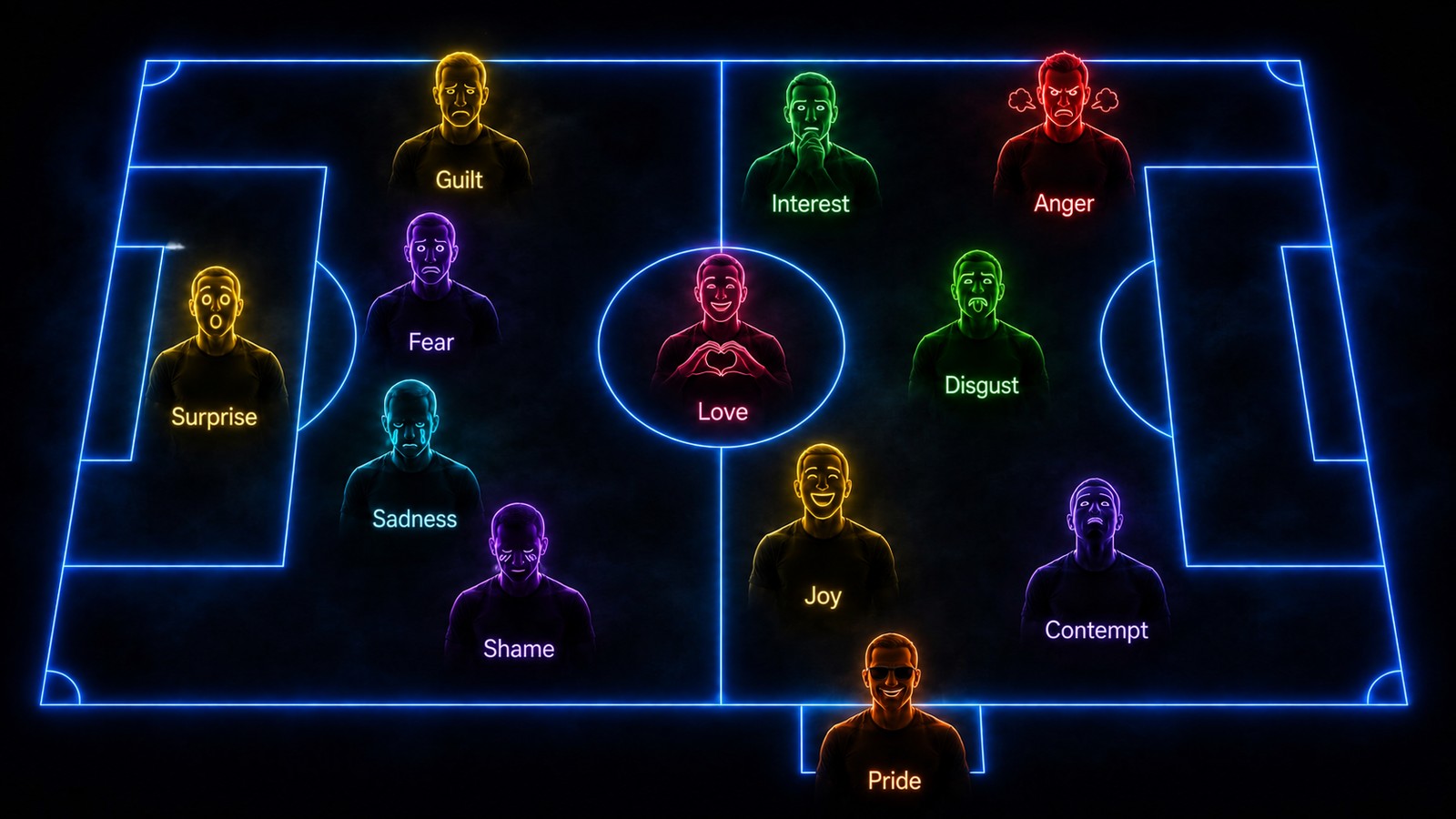
Twelve emotions, one team: each has a part to play.Image: TradeNeon

No coach in the world — especially Germany's new national team coach, Jürgen Klopp — would send a team out without a defense. In trading, many people do exactly that — they let only the emotions they happen to like take the field, then wonder why the game falls apart.

Emotions are the driving force behind what we do — at the screen just as much as on the pitch. So it makes little sense to work only on the surface, on the behaviour, when you want to change your "irrational" trading. The real starting point lies deeper: with the emotions themselves — and with the relationship between mind and feeling.

01

Emotions: the energy behind what you do

You know the moment. The trade goes against you, your pulse climbs — and suddenly the plan you laid out so calmly is gone. You click, even though you know better. What happens there is not a character flaw. It is biology. Once you understand it, you can deal with it differently.

Inside your head, several networks work together. The prefrontal cortex (PFC) helps you as a calm strategist to weigh things up, plan and stay on task. Networks that process danger and stress can trigger a rapid alarm response.

Under strong stress, this teamwork can fall out of rhythm: the alarm response gains weight while careful planning becomes harder. The medial PFC helps shape how your body responds to stress and mobilises or limits energy resources (McKlveen et al., 2015).

When stress grows too strong — and trading offers plenty — it becomes harder to keep your plan in view. Not because you are weak, but because your brain is responding to a possible threat. The strategist loses influence, and instinct grabs the wheel.

A person with a coach's whistle holding a bunch of neon emotion-face balloons that hide their face
When emotions take over. Feelings you don't understand block the view — and headless trading begins.

This is also why trying to simply switch emotions off never works. It is like a coach trying to steer his players from the touchline by willpower alone — against the forces out on the pitch, he gets nowhere. The good news: there is a better way than shouting at them. But for that we need to ask, briefly, who is actually playing against whom.

02

Is the mind the real problem?

Emotions often get blamed for blackouts, overtrading, FOMOFOMO stands for “Fear of Missing Out” – the fear of missing a move or an opportunity. (the fear of missing out), FOBOFOBO stands for “Fear of Better Options” – the fear that a better opportunity might come along any moment. (the fear of a better option coming along), revenge tradesA revenge trade is an attempt to immediately “win back” a previous loss. and other missteps. These patterns are among the most common trading mistakes — and they can have an emotional root.

At first glance the case looks clear: the emotions are guilty. But the real problem lies neither in the emotions nor in the mind — it lies in the communication between the two. It is about an exchange as equals. And do we really meet our emotions as equals?

Our culture also shapes how we think and talk about feelings. Perhaps you know the habit of putting reason above emotion and looking down on what you feel. Neckel and Pritz (2019) describe emotions as a link between individuals, culture and social structures.

If you place reason above emotion, you may, as a "person of reason", end up in a tug-of-war with your own players. Because emotions also influence your behaviour, that struggle can make decisions harder under pressure.

How about a change of perspective? We are not only our mind, but also our emotions. Learn to bring your players onto your side instead of playing against them, and you become stronger than ever — free, at last, to focus on the trading itself. Most traders do the opposite and fight themselves. A game nobody wins. Why not use the power of your emotions to grow as a person?

03

Understanding emotions and their functions

First, treat every emotion as a clue that may have a function. The key is to understand those clues and communicate with your emotions as equals. Emotions and reason are partners. Neurobiology offers the same picture: feeling and thinking emerge through the interplay of brain and body. Their networks influence each other and what we do.

But which emotions actually influence our behaviour? Research disagrees on how many there are. Paul Ekman describes seven universal emotional expressions: surprise, fear, anger, disgust, contempt, sadness and joy. For our emotion team, we use a different model as well: Dirk Eilert works with twelve primary emotions.

Alongside the seven emotions named by Ekman, Eilert's model includes shame, guilt, love, pride and interest. Those twelve form the line-up for our emotion team. Emotions can influence perception, thinking, memory and what we do.

04

Your emotion team on the pitch

Compare these twelve emotions to a football match and they fall into three groups — with surprise acting as a neutral pivot and pride as the "coach on the sideline".

A pitch line-up of twelve emotions with English labels: defense, midfield, attack and pride as the coach
The line-up. Twelve primary emotions, three rows — and a coach who decides who plays.
Defense Protection & boundaries
  • Fear
  • Sadness
  • Shame
  • Guilt
Midfield Connection & building
  • Interest
  • Joy
  • Love
Attack Assertion & defense
  • Anger
  • Contempt
  • Disgust

A good coach would never field a national team without a defense or an attack. In trading, many do precisely that. Perhaps you suppress your fear or your sadness but act out your anger, because it gives you a sense of agency.

To stay able to act in trading, it helps to keep the whole emotion team in view — all twelve emotions in Eilert's model. Emotions let us step back from outside stimuli, move toward them, or push them away. Emotion as a movement of feeling: your individual way of responding to what's in front of you.

Keep one thing in mind: trading is stress for our system. As the coach, your job is to set up your emotion team and prepare it for the match. Without a plan you lose — and your players just do something. Above all the ones you'd rather keep off the pitch, but who are there anyway and whom you never train. If you keep pushing feelings away, inner pressure can grow. Then it becomes harder to decide clearly. The classic headless trading can begin — and lead to FOMO, FOBO, revenge trades and overtrading. You know the list.

The point

It makes far more sense to ally with your emotions than to try to ignore and suppress them. A coach who benches half the squad never wins a match.

05

How to ally with your emotions

The first step is to notice your emotions and get to know them. After each trading session, take time to reflect: which emotions did you feel? At what point did one get so intense that it drowned out your rational thinking?

A useful tool here is to sort them by "temperature" — from hot to cold. This grading helps you see when an emotion grew too strong and started to drive your actions. By acknowledging your emotions and training them, you can put them to work for your trading instead of fighting against them.

Conclusion

Trading is stress for our system. As the coach of your emotion team, your job is to understand your emotions, accept them and use their energy. Learn to communicate with them as equals — and you will find that emotional intelligence can be a genuine advantage in trading.

This is not an extra burden you take on. It is rather the opposite: those who stop playing against themselves trade more lightly — not more grimly.

Every emotion can have a function. Fear can point to a need for safety, anger to a boundary. Sometimes it helps to regulate an emotion, sometimes to give it room. What matters is the context in which it appears.

Take the first step and say "hello" to your emotions. Be curious about what they have to tell you, and use their power to take your trading to the next level.

Glad you're here.
Marnie

Frequently asked questions
Are emotions a disadvantage in trading?

No. Emotions are the energy behind every decision. Suppress them for a long time and you may miss important information. The advantage appears when you learn to notice and use them instead of fighting against them.

Can you control your emotions while trading?

You can't simply switch them off — under strong stress, careful planning can become harder. Instead of control, what helps is communication as equals: notice your emotions, place them, and put their energy to deliberate use.

What is meant by the emotion team?

A picture for the twelve primary emotions in Dirk Eilert's model, which help shape your experience. Like a squad, you need access to every position — defense, midfield and attack — instead of acting out a few emotions and suppressing the rest.

How do I reflect on my emotions after trading?

Take time after each session: which emotions were there, and at what point did one get so intense that it drowned out your rational thinking? Sorting them by temperature — from hot to cold — helps you spot when an emotion grew too strong.

Marnie Aramruck
Marnie Aramruck
Founder & Head of Brand & Psychology · TradeNeon
Marnie Aramruck came to trading by an unusual route: ten years self-employed in event management, marketing and design, before turning to the psychology behind decisions. As a master emotion coach and resilience trainer, she now works on a single question: what traders need in order to stay calm and clear even under pressure. Her subject is not the chart, but the person in front of it.
Ten common trading mistakes — and how to avoid them

Ten common trading mistakes — and how to avoid them

A trader at a desk, surrounded by ten neon icons representing common trading mistakes
Trading psychology Fundamentals

Ten common trading mistakes — and how to avoid them

We look at the ten main reasons why, in our view, so many private traders struggle to trade successfully over the long term.

Ten common mistakes, and the decisions behind them.Image: TradeNeon

Frankly, each of these reasons could easily fill an entire article of its own. Here, we want to give you a concise overview and a few things to think about. Let’s get started.

Put loss rates in context

A 2018 ESMA review put the share of loss-making retail CFD accounts in the EU markets examined at 74 to 89 percent. This is a historical figure for CFD trading, not a rate for all brokers, products or traders. Source: ESMA.

The frequently quoted loss rates come from CFD risk warnings. Providers are required to disclose the proportion of their retail CFD accounts that lose money. The earlier ESMA review cites 74 to 89 percent for the EU markets examined. These figures cannot establish a success rate for day trading as a whole or for other trading instruments.

Unfortunately, there is considerable frustration in our industry, and many people online firmly believe that trading simply does not work. In the original article, I referred to a statement from a Handelsblatt podcast. Without the specific episode and the studies it mentioned, that statement cannot be checked here. Day trading is a profession, not a sure thing, and it certainly does not suit everyone. It takes considerable experience and knowledge. The fact that people day trade is not, however, evidence that it is profitable for everyone.

Many private traders underestimate risk, the learning involved and costs. So we sat down to consider the main reasons why people might struggle with trading. As you can imagine, quite a few came to mind. We would like to introduce the ones we consider most important, so you can prepare for them and hopefully avoid them. The following ten points are our editorial assessment, not a statistical ranking.

One thing before we begin: many of these points will probably seem obvious to you, yet they cause serious problems for so many people in everyday trading. Others are much less obvious, but in my view these can ultimately make a significant difference.

Ten common mistakes
01

Psychology and mindset

Ask a trading coach about the reasons people struggle with trading, and psychology and mindset will often come up. Under pressure, protective reactions can influence your decisions. That might be an instinct to escape, causing you to close a trade against your plan, or an urge to defend yourself or counterattack that makes you want to fight the market.

When you speculate, it is important to work on how you deal with these impulses. The aim is to notice them and examine your response, rather than trying to suppress your feelings entirely. That makes a sound trading plan and a well-developed strategy all the more important, so you can make your decisions as rationally as possible.

02

False expectations

Here we have to take a critical look at our industry as a whole. Many people associate the stock market, and speculative trading in particular, with a casino where a little luck can quickly bring them a fortune. That idea is fuelled by adverts from trading coaches and schools showing attractive people driving expensive cars and living a luxury lifestyle. Some promise extraordinary returns that the system being taught cannot come close to delivering.

That is unfortunate, because trading is a demanding professional activity with substantial financial risks. How much money you can make or lose also depends on the capital available to you and the risk you take. A serious, professional trader should manage their account with sound risk and money management. They should avoid disproportionate risks or putting their entire account at stake in pursuit of quick money. Even a disciplined approach does not guarantee steady account growth.

03

Expecting results too soon

As you can see, this reason follows directly from the previous one. In fact, as we thought through the subject, we found that many of the reasons overlap and connect. One cause can lead to the next, leaving you with a range of factors holding you back.

You do not learn trading overnight. It is not rocket science, but it still has to be learned. Experience plays a particularly important role. Learning a system, even understanding it completely, does not mean you can immediately apply it profitably. First, you need to become familiar with how it works, the technical procedures and, of course, the markets and their different characteristics.

That means setting aside some time every day to practise, especially at the beginning. Depending on the approach and trading discipline you want to learn, you may need considerably more time. If you are interested in day trading (programme information in German), in particular, we are talking about several hours a day. That can be exhausting when you are learning alongside your regular job. Trading will NOT make you rich overnight. That much I can tell you for certain. You need perseverance, which brings us straight to point four: impatience.

04

Impatience

Even if you have managed to make the necessary time for trading every day, that does not mean you can immediately put everything you have learned and practised into action. You need patience and staying power. We all learn at different speeds and start with different levels of knowledge. How long you need to master a discipline such as day trading (programme information in German) or swing trading (programme information in German) also depends on your practice time and the quality of your training. You may understand a trading system more quickly, but that does not establish a fixed timetable for applying it competently or becoming profitable.

Impatience will only encourage mistakes. Worse still is giving up on an approach too quickly. We often see beginners abandon a system whose rules they have not yet examined thoroughly, simply because they cannot put it into practice quickly enough.

05

The trading system does not work

Almost more often, though, we encounter the opposite, which brings us to reason five: you are trying to trade a system that simply does not work.

Here, too, it is worth looking at the internet, particularly YouTube. It is striking how many brightly coloured thumbnails now compete for your attention on the home page. They advertise strategies you can apply quickly, along the lines of: SMA 1 crosses SMA 2 and the last three candles were all purple-peach-green. An entry pattern like that does not tell you whether a complete trading system works. That also requires exits, risk rules and a transparent assessment after costs.

An approach explained publicly can be a useful starting point for learning. Whether it is viable in your own trading only becomes clear through a transparent assessment that includes costs, losing periods and clear rules. Look for evidence you can check, rather than adopting a strategy solely because of a video or a promise. You can take the initiative and develop your own strategies, which we strongly encourage, or find a capable teacher to help you learn trading. Your own initiative and a good coach can complement each other; they cannot guarantee lasting success.

06

The wrong trading coach

You have chosen the wrong teacher. We need to be careful here, of course: we do not want to offend colleagues. Still, it is no secret that our industry includes fraudsters and people with questionable practices. Here is a brief checklist to help you assess a sound trading school:

  • Use your judgement of people: how does the trader conduct themselves?
  • Do they speak factually and informatively, or boast about their possessions and talk mainly about their successes rather than sharing their knowledge?
  • How old is the coach? Do you feel they bring some life experience?
  • More importantly, do you think they can teach well? A trader may be very successful at their job without necessarily being a good teacher.
  • Do they make an effort to disclose their performance in some form?
  • Can you reach them with questions, and do they respond promptly and competently?

We probably do not need to tell you that your trading coach plays a significant role in how quickly you reach your goal, or whether you reach it at all.

07

You do not manage risk

This point should be well known by now, but we have to keep emphasising its importance. You may be psychologically resilient and have an excellent trading system. You may even avoid all the other mistakes mentioned in this article. Yet if you cannot manage your money and trading risk properly, you will end up losing money or even wiping out your account.

Entire books have been written about this subject. Fundamentally, it concerns when you close a trade, whether it is in profit or loss, and how much capital you can and want to risk on each trade relative to your total capital. That varies considerably between systems and individual circumstances. You MUST, however, consistently follow a defined set of rules, or you will struggle in trading over the long term.

08

The wrong trading instruments

You can also make things harder for yourself by trading the wrong instruments. If you choose your broker because of its impressive advertising around Bundesliga football pitches, for example, that tells you nothing about its trading terms. Of course, we are not condemning broker advertising in general; everyone needs some way to attract attention. What matters is the actual terms for your trading.

Before choosing an instrument, check where and with whom you trade, how prices are formed, and the costs and risks involved. CFDsContracts for difference: speculation on price movements without owning the underlying asset, traded off exchange through a provider and made highly risky by leverage. are generally traded over the counter with a provider; retail spot forexForeign exchange: trading currencies such as EUR/USD. Retail spot forex is often traded over the counter; currency futures and options can be traded on an exchange. is also often traded over the counter. Currency futures and options, however, can trade on an exchange. Source: Investor.gov. “Zero commission” does not mean your trading is entirely free: depending on the product and provider, spreads, financing costs or other fees may apply.

Exchange-traded examples include shares, ETFs, bonds, futuresStandardised contracts traded on an exchange that oblige the parties to buy or sell an underlying asset at a specified price and date. and optionsExchange-traded contracts giving the right, but not the obligation, to buy or sell an underlying asset at a specified price.. You can lose money there, too. In particular, compare product structure, liquidity, leverage, costs and counterparty risk.

Exchange traded

ExamplesShares, ETFs, futures and listed options; some warrants also trade on an exchange.

StructureTrading takes place at a venue under its rules. Risks and costs remain.

Over the counter

ExamplesCFDs and spot forex through a provider.

StructurePricing and the counterparty depend on the provider and contract.

Do not confuse the products

Listed options and warrants are different products. Warrants are issued by an issuer and can also trade on an exchange, with the issuer generally quoting buying and selling prices. Source: Frankfurt Stock Exchange (German).

09

Blind trust in supposed experts

We are nearing the end and come to point nine: placing too much trust in supposed experts. If you think successful trading requires watching the news from morning to night and reading every possible expert forecast, I can reassure you that it does not. Experts can also get their forecasts wrong. A single correct prediction does not establish forecasting reliability; in hindsight, it is easy to find someone who predicted what happened.

In the morning, I listen to a business news podcast to catch up on the financial world, and in the evening I watch Tagesschau, the German television news programme. That is my personal news routine. Unless you specifically trade the news, you do not need to follow every story. Which events and announcements you need to monitor does, however, depend on your market, holding period and approach.

We would strongly advise against making investments solely on the basis of a supposed expert’s opinion, especially if you do not know that expert’s background or find it difficult to assess. At TradeNeon, our principle is that you should take charge of your own finances and understand your decisions.

10

Markets change

Now we come to the final point, and in my view the most important one. If you believe you have consistently addressed all nine of the preceding points in your everyday trading but are still struggling, it is worth examining how the markets have changed. This is less obvious than many other mistakes and, in my view, often underestimated. Adapting to such changes makes trading demanding.

You may have heard of the Turtle Traders. Richard Dennis and William Eckhardt taught a group of participants a rules-based system for trading futures. It covered not just entries, but also exits, position sizing and stops. The Turtle Traders are therefore a historical example of learning a complete trading system. Their story cannot establish the returns of a system traded today. Source: Original Turtles.

Market structure, liquidity and competition change. As an approach becomes widely known and more market participants trade it, its conditions can change. Electronic trading has also changed markets. That does not establish a verifiable, universal end date for the Turtle system, however. Any rules-based approach requires checking whether its assumptions still hold in today’s market.

An entry such as “SMA 1 crosses SMA 2 from below and you go long” initially describes just one rule. You need to test whether a system built around it is viable in the relevant markets and conditions. Even an approach that worked for several years may later lose its edge. Markets are constantly changing; past results do not guarantee future performance.

Electronic and algorithmic trading change market conditions. You need to understand how markets work and recognise when they change. This brings us to an important point that we explore in detail in our day trading programme: in our view, there are two questions you should ask when trading, particularly when day trading. WHERE is a relevant price area, and WHAT actually happens there? In our approach, we check both. These are checks, not a guarantee of success.

The two key questions

WHERE does the price need to go for me to trade, and WHAT needs to happen THERE for me to trade? Our approach combines both observations. First, decide where you want the price to go. When it reaches that area, you do not enter blindly: you wait for a particular setup to form at that price level. Only when THAT happens do you trade.

Frequently asked questions
What do the familiar loss rates describe?

The frequently quoted risk warnings refer to a provider’s retail CFD accounts. A 2018 ESMA review cites 74 to 89 percent loss-making CFD accounts in the EU markets examined. This is not a general rate for all traders.

How long does it take to learn trading?

That depends on your prior knowledge, available practice time, market and method. Learning a set of rules replaces neither experience nor an assessment of your own results. There is no reliable fixed timetable to profitability.

How do I assess a strategy from a video?

Test the rules across enough trades and market conditions, including fees, slippageSlippage is the difference between the expected execution price of an order and the price at which it is actually filled. and losing streaks. A video alone does not establish a viable strategy.

What should I check with CFDs and spot forex?

Both can be traded over the counter. Check leverage, costs, pricing, the counterparty and the provider’s regulatory status. Exchange-traded instruments have different structures but are not risk-free.

What is the most important mistake to avoid?

The reasons overlap. A missing risk limit can undermine even a good analysis. Realistic expectations, patience and examining your own decisions are just as important; none of these measures guarantees a profit.

I hope you enjoyed this article and learned something useful. We were surprised ourselves at how many reasons came to mind for why private traders often struggle. These ten points give you questions to examine in your own trading. A plan, an appropriate risk budget and an honest review help make your decisions understandable and accountable. Losses remain possible even with good preparation.

Day trading programme
If you are curious, find out more about our day trading programme: individual, in-depth training in professional day trading. We specifically address these two questions and explain WHAT should happen WHERE. The programme and the linked programme information are currently available in German.
Learn more (German)
Oliver Sparing
Oliver Sparing
Founder & Head of Trading · TradeNeon
Oliver Sparing has been actively trading the financial markets since 2011. His professional roots lie in precious metals trading in Hamburg; in 2017 he learned at a London trading floor. At TradeNeon he leads the day trading and swing trading programmes and is responsible for the trading methodology, with a focus on order flow, market structure and fundamental market data. Level of Interest, Futures Insights and Lab of Trades grew out of this work. Platforms such as ATAS, Bookmap and WH SelfInvest regularly invite him as a guest. All guest appearances