
Train your inner emotional team

Emotions in trading have a bad reputation — blamed for blackouts, overtradingInstead of selectively trading only the best and most promising opportunities, you jump enthusiastically into every trading opportunity, however small. and impulsive trades. But what if they are not your opponent, but a team that can play for you? How to turn your emotions from a rival into an ally.
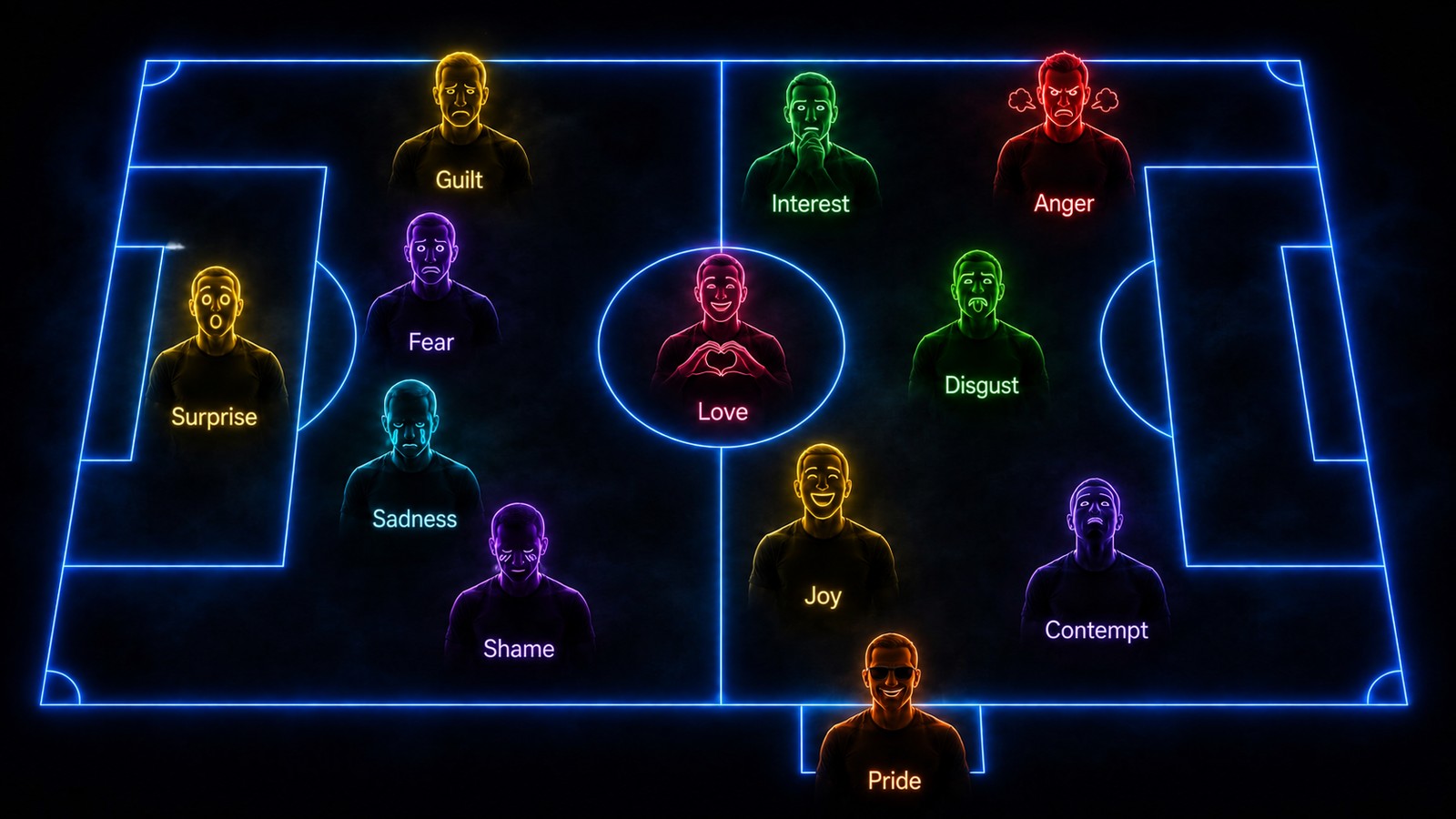
Twelve emotions, one team: each has a part to play.Image: TradeNeon
Field your whole team.
No coach in the world — especially Germany's new national team coach, Jürgen Klopp — would send a team out without a defense. In trading, many people do exactly that — they let only the emotions they happen to like take the field, then wonder why the game falls apart.
Emotions are the driving force behind what we do — at the screen just as much as on the pitch. So it makes little sense to work only on the surface, on the behaviour, when you want to change your "irrational" trading. The real starting point lies deeper: with the emotions themselves — and with the relationship between mind and feeling.
Emotions: the energy behind what you do
You know the moment. The trade goes against you, your pulse climbs — and suddenly the plan you laid out so calmly is gone. You click, even though you know better. What happens there is not a character flaw. It is biology. Once you understand it, you can deal with it differently.
Inside your head, several networks work together. The prefrontal cortex (PFC) helps you as a calm strategist to weigh things up, plan and stay on task. Networks that process danger and stress can trigger a rapid alarm response.
Under strong stress, this teamwork can fall out of rhythm: the alarm response gains weight while careful planning becomes harder. The medial PFC helps shape how your body responds to stress and mobilises or limits energy resources (McKlveen et al., 2015).
When stress grows too strong — and trading offers plenty — it becomes harder to keep your plan in view. Not because you are weak, but because your brain is responding to a possible threat. The strategist loses influence, and instinct grabs the wheel.

This is also why trying to simply switch emotions off never works. It is like a coach trying to steer his players from the touchline by willpower alone — against the forces out on the pitch, he gets nowhere. The good news: there is a better way than shouting at them. But for that we need to ask, briefly, who is actually playing against whom.
Is the mind the real problem?
Emotions often get blamed for blackouts, overtrading, FOMOFOMO stands for “Fear of Missing Out” – the fear of missing a move or an opportunity. (the fear of missing out), FOBOFOBO stands for “Fear of Better Options” – the fear that a better opportunity might come along any moment. (the fear of a better option coming along), revenge tradesA revenge trade is an attempt to immediately “win back” a previous loss. and other missteps. These patterns are among the most common trading mistakes — and they can have an emotional root.
At first glance the case looks clear: the emotions are guilty. But the real problem lies neither in the emotions nor in the mind — it lies in the communication between the two. It is about an exchange as equals. And do we really meet our emotions as equals?
Our culture also shapes how we think and talk about feelings. Perhaps you know the habit of putting reason above emotion and looking down on what you feel. Neckel and Pritz (2019) describe emotions as a link between individuals, culture and social structures.
If you place reason above emotion, you may, as a "person of reason", end up in a tug-of-war with your own players. Because emotions also influence your behaviour, that struggle can make decisions harder under pressure.
How about a change of perspective? We are not only our mind, but also our emotions. Learn to bring your players onto your side instead of playing against them, and you become stronger than ever — free, at last, to focus on the trading itself. Most traders do the opposite and fight themselves. A game nobody wins. Why not use the power of your emotions to grow as a person?
Understanding emotions and their functions
First, treat every emotion as a clue that may have a function. The key is to understand those clues and communicate with your emotions as equals. Emotions and reason are partners. Neurobiology offers the same picture: feeling and thinking emerge through the interplay of brain and body. Their networks influence each other and what we do.
But which emotions actually influence our behaviour? Research disagrees on how many there are. Paul Ekman describes seven universal emotional expressions: surprise, fear, anger, disgust, contempt, sadness and joy. For our emotion team, we use a different model as well: Dirk Eilert works with twelve primary emotions.
Alongside the seven emotions named by Ekman, Eilert's model includes shame, guilt, love, pride and interest. Those twelve form the line-up for our emotion team. Emotions can influence perception, thinking, memory and what we do.
Your emotion team on the pitch
Compare these twelve emotions to a football match and they fall into three groups — with surprise acting as a neutral pivot and pride as the "coach on the sideline".
- Fear
- Sadness
- Shame
- Guilt
- Interest
- Joy
- Love
- Anger
- Contempt
- Disgust
A good coach would never field a national team without a defense or an attack. In trading, many do precisely that. Perhaps you suppress your fear or your sadness but act out your anger, because it gives you a sense of agency.
To stay able to act in trading, it helps to keep the whole emotion team in view — all twelve emotions in Eilert's model. Emotions let us step back from outside stimuli, move toward them, or push them away. Emotion as a movement of feeling: your individual way of responding to what's in front of you.
Keep one thing in mind: trading is stress for our system. As the coach, your job is to set up your emotion team and prepare it for the match. Without a plan you lose — and your players just do something. Above all the ones you'd rather keep off the pitch, but who are there anyway and whom you never train. If you keep pushing feelings away, inner pressure can grow. Then it becomes harder to decide clearly. The classic headless trading can begin — and lead to FOMO, FOBO, revenge trades and overtrading. You know the list.
It makes far more sense to ally with your emotions than to try to ignore and suppress them. A coach who benches half the squad never wins a match.
How to ally with your emotions
The first step is to notice your emotions and get to know them. After each trading session, take time to reflect: which emotions did you feel? At what point did one get so intense that it drowned out your rational thinking?
A useful tool here is to sort them by "temperature" — from hot to cold. This grading helps you see when an emotion grew too strong and started to drive your actions. By acknowledging your emotions and training them, you can put them to work for your trading instead of fighting against them.
Trading is stress for our system. As the coach of your emotion team, your job is to understand your emotions, accept them and use their energy. Learn to communicate with them as equals — and you will find that emotional intelligence can be a genuine advantage in trading.
This is not an extra burden you take on. It is rather the opposite: those who stop playing against themselves trade more lightly — not more grimly.
Every emotion can have a function. Fear can point to a need for safety, anger to a boundary. Sometimes it helps to regulate an emotion, sometimes to give it room. What matters is the context in which it appears.
Take the first step and say "hello" to your emotions. Be curious about what they have to tell you, and use their power to take your trading to the next level.
Glad you're here.
Marnie
Are emotions a disadvantage in trading?
No. Emotions are the energy behind every decision. Suppress them for a long time and you may miss important information. The advantage appears when you learn to notice and use them instead of fighting against them.
Can you control your emotions while trading?
You can't simply switch them off — under strong stress, careful planning can become harder. Instead of control, what helps is communication as equals: notice your emotions, place them, and put their energy to deliberate use.
What is meant by the emotion team?
A picture for the twelve primary emotions in Dirk Eilert's model, which help shape your experience. Like a squad, you need access to every position — defense, midfield and attack — instead of acting out a few emotions and suppressing the rest.
How do I reflect on my emotions after trading?
Take time after each session: which emotions were there, and at what point did one get so intense that it drowned out your rational thinking? Sorting them by temperature — from hot to cold — helps you spot when an emotion grew too strong.