Investing sounds prudent; speculation sounds dangerous. Yet a long time horizon does not make a decision sound by itself, and a short one does not make it foolish. Your goal, your reasoning and the risk you actually take matter more.
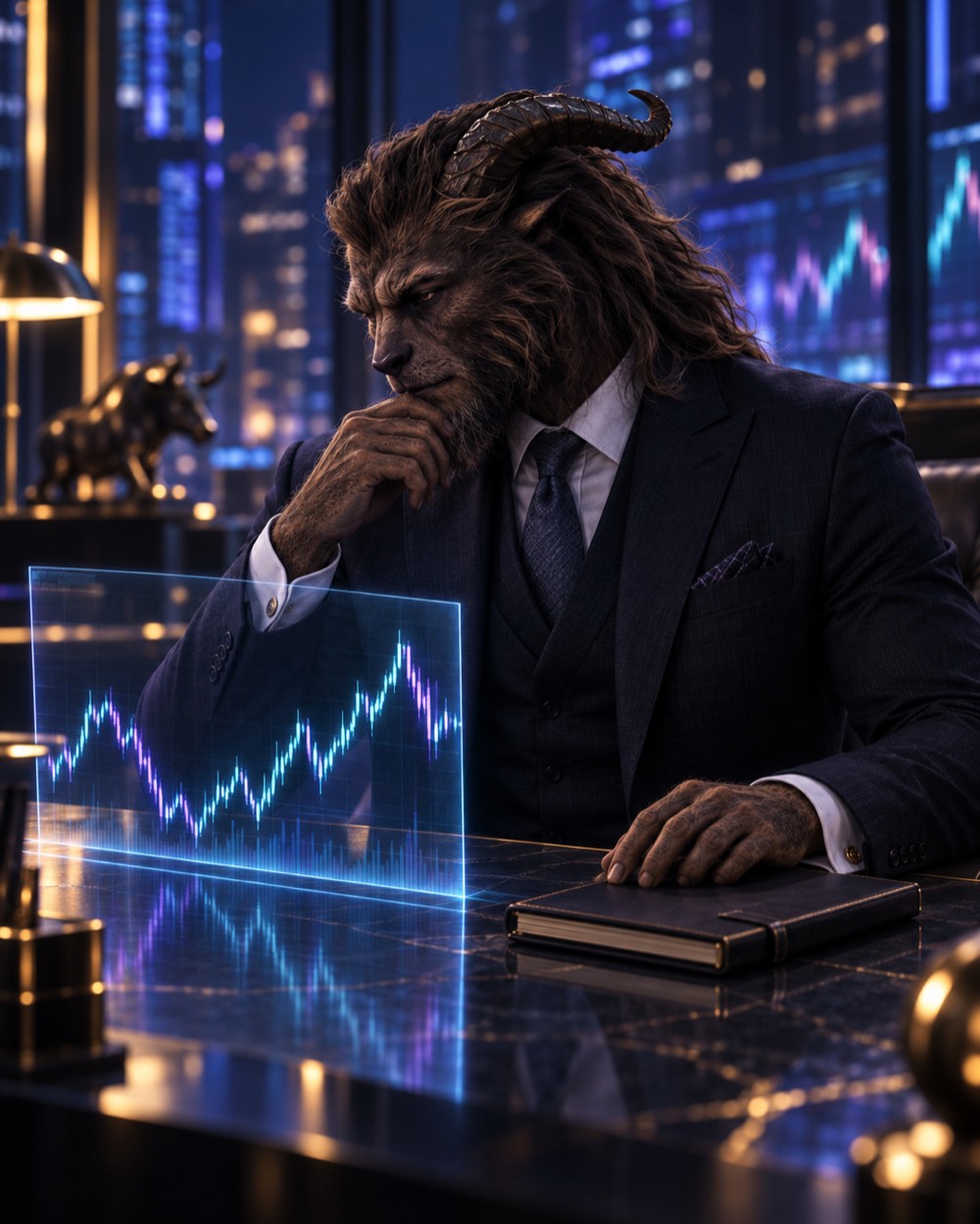
The plant and chart stand for two approaches, neither of which guarantees an outcome.Image: TradeNeon
Two ways into a market. Both require judgement.
What the terms mean, where they overlap and how to assess their risks.
Whether you are new to markets or have years of experience, you will have heard the words “investing” and “speculating”. It often seems obvious which sounds better. I felt the same, although I do both. So let me start with a question: Which sounds more positive to you, “I invest in the market” or “I speculate in the market”?
Investing may bring patience and foresight to mind; speculating may suggest bets and quick gains. That difference in how the words sound is where this article begins. It says little about how someone actually makes decisions or what risk they take. Let us look at the terms, their place in market history and, finally, the question of when a trading idea amounts to more than hope.
The key distinction
Investing and speculating are not moral opposites. An investment usually centres on a longer-term goal and the development of an asset; speculation centres more strongly on an expected price move. Either can be thoughtful or careless. Both can lose money.
01
Two terms, no fixed boxes
Why does one word sound so much more reassuring? In everyday language, to invest is to devote money, time or effort to something. It suggests building for the future. By contrast, the German verb for “speculate” can mean either to expect something or to conjecture, as the Duden dictionary shows. One meaning sounds calculated, the other uncertain. Language helps explain the reputation.
Public images differ too. Investors are often portrayed as patient thinkers who support businesses, while speculators appear as gamblers who drive prices. Both images simplify reality. Holding an asset for years does not show whether the purchase was well reasoned; a short-term position need not be impulsive.
If you hold a stock for years, you may be investing in the future of its business. If you buy the same stock because you expect a short-term move, your decision is closer to speculation. The instrument does not settle the question; your time horizon, reasoning and risk plan say more.
The boundary remains blurred. Long-term investors also form expectations about the future, while traders may base their decisions on data and defined rules. These labels help explain an approach; they do not assess any individual trade for you.
02
Beauty: investing for a longer goal
The plant represents a long planning horizon, not assured growth. Image: TradeNeon
For a longer-term investment, ask what the money is meant to accomplish, how long it can remain invested and which fluctuations you can tolerate without abandoning your plan at a difficult moment.
DiversificationSpreading capital across different investments to reduce the impact of a single holding. Losses remain possible. can limit exposure to one company or market. It cannot remove general market risk or prevent all losses. The SEC's investor guide to time horizon and diversification treats both as starting points for an investment decision.
“Long term” is no safety guarantee. A concentrated stock position, an unsuitable time horizon or borrowed money can make a supposed investment highly risky.
03
The beast: speculating on price
The Latin speculari means to watch or observe. The word's origin is a reminder that speculation can involve observation and a view of what may happen next. Etymology does not show that every present-day trade is carefully analysed. A market view can be built on evidence or simply guessed.
A market view also needs a plan for the possibility that it is wrong. Image: TradeNeon
SpeculationSpeculation is buying or selling an asset because you expect its price to change. makes an expected price change central to the decision. The horizon may be short or longer. A trade needs a clear thesis, rules for entry and exit, and a controlled position size.
Take particular care with leverageBorrowing or derivatives allow a larger market exposure than the capital committed. Gains and losses can both be amplified.. The SEC's investor bulletin explains why leveraged positions can carry substantial additional risk.
Reasoned speculation is no promise of profit. Without rules, a trade can turn into wishful thinking; with rules, mistakes and losses remain possible.
04
What speculation can do for markets
Why, then, does speculation have a poor reputation? Exuberant expectations and buying with borrowed money played a part before the 1929 stock market crash. The boom of the 1920s attracted more investors, some of whom paid for only a small share of their stocks with their own funds. When prices fell, debt increased the pressure. Yet the crash and the Great Depression had several causes. Neither speculators nor a single emotion can explain them on their own.
In futures markets, speculators may take the other side of positions that commercial participants want for hedging. They can thus contribute to market liquidityMarket liquidity describes how easily an instrument can be traded without one order moving its price sharply. and price discovery. That does not mean every speculative trade makes prices stable. The US futures regulator discusses both their contribution and the limits of that claim.
A village market makes the possible effect easier to picture. Three sellers offer identical cartons of eggs for three, five and seven euros. Once the cheapest cartons sell out, buyers face a sharp jump to the next price. If more sellers offer cartons at prices in between, buyers see more choice and smaller gaps between offers. In financial markets, additional buy and sell orders can likewise make trading easier. But the example does not prove lasting price stability. In a panic, many participants may rush to the same side at once.
For commodities such as oil or wheat, the need for counterparties is especially clear. Producers and users hedge against price changes; speculators can take the other side of those trades. Whether a particular market is calmer as a result depends on supply, demand, market structure and participant behaviour.
The 1929 crash shows the danger of excess and borrowed money. From its September 1929 high to July 1932, the Dow Jones fell about 89% – not within a few weeks. Causes and consequences reached far beyond the decisions of individual speculators. Federal Reserve History documents the timeline.
The economic consequences were severe: banks came under pressure, credit tightened and unemployment rose. Responses to financial crises later included deposit insurance and stronger requirements for banks. These measures emerged at different times and for different reasons; they are not a single set of immediate responses to the October crash.
Market-wide circuit breakers were not an immediate response to 1929, either. The coordinated US trading-halt rules followed the crash of 1987, according to the SEC.
05
Do rules make speculation predictable?
Can speculative trading amount to more than gambling? A trade without a reasoned thesis, limited risk or a plan for being wrong resembles a wager. A planned trade can instead be examined. That does not mean it will win, or that rules alone create an edge.
A system can make decisions comparable and open to review. The efficient-market hypothesisThe efficient-market hypothesis examines how available information is incorporated into market prices. is a reminder of how difficult a lasting edge may be. It is not a claim that every active approach must fail. Fama's research review distinguishes different information sets and tests.
Even a comparison with an index demands care. Beating a broad stock index over a short period may be luck. Longer records must also account for risks, costs and a suitable benchmark. The efficient-market hypothesis provides a framework for such tests. It is neither a mathematical proof that every trader must fail nor a licence to assume that one's own method is an exception.
A backtestApplying predefined trading rules to historical data. A good historical result does not prove future profits. can show how rules would have behaved in past data. Hindsight, overfitting and omitted trading costs can distort it. Testing in a demo account adds observations, but does not reproduce real execution under financial risk. The CFTC specifically warns about hypothetical results.
Backtesting and forward testing are two different stages: first examine predefined rules against historical data, then observe them on new data or in a demo account. The key is not to rewrite the rules after each poor result and then present the revised backtest as an independent test. Even a favourable result provides clues, not a reliable forecast for your own account.
In their 2007 review, Park and Irwin found 56 positive, 20 negative and 19 mixed results among 95 more recent studies of technical trading strategies. That is one reason why a blanket “it never works” is too simple. The authors also discuss problems including data selection and differences in methods. The studies examine different markets and strategies. They do not show that a particular course, trader or reader will outperform a benchmark in future.
The newer data-driven strategies mentioned in the original are not recipes that transfer directly to an individual account. Some research assumes data, infrastructure or execution that retail traders do not have. Isolated examples and monthly returns without an appropriate comparison can distort expectations. To judge a method, ask for a complete record, costs, losing periods and practical feasibility.
A test, not a promise
Ask which data were available before a trade, how costs and losing periods were counted, and when the method would be rejected. One compelling example is no substitute for a reliable record.
06
Which approach serves your goal?
Is speculation the beast of the market, then? The answer depends on the behaviour you mean. Overconfidence, heavy borrowing and decisions made in panic can cause harm. Observation, a plan that can be tested and limited risk can provide a basis for a trade. Even then, the outcome remains uncertain. A systematic method does not become profitable merely because it has rules.
Investing and speculating are therefore not moral roles you must choose between once and for all. Both involve an uncertain future. They often differ in what you expect to happen, how long you commit capital and what work a decision requires. Someone seeking to build wealth over many years asks different questions from someone trading a particular price move.
Investing
Question: What should this capital accomplish over a longer period?
Work: Define your goal and horizon, diversify and review the plan.
Risk: Price swings, losses and unsuitable choices of asset or timing.
Speculating
Question: Which price move do I expect, and what would invalidate the idea?
Work: Analyse the market, set trading rules, document decisions and manage risk.
Risk: Losing trades, costs, execution problems and amplified losses with leverage.
You do not have to choose a character. Long-term investing and active trading can serve different purposes. Treat each with its own goal, suitable capital and a plan you can test.
Perhaps “I speculate” now sounds less like a synonym for gambling, while “I invest” sounds less like a guarantee of safety. The label cannot protect you from a mistake. Ask instead: Why am I taking this position? What would invalidate my reasoning? What loss could I bear? That turns the picture of beauty and beast into a concrete market decision.
TradeNeon Academy
Explore the learning paths
From stocks and ETFs to structured trading education: compare the content and requirements at your own pace. Programmes are currently offered in German.
No. Holding an asset for longer does not remove market risk or the risk of an unsuitable investment. The type and duration of the risk often differ.
Is speculation the same as gambling?
Not necessarily. A reasoned market view with defined rules differs from a random bet, although it cannot secure a profit.
Does a backtest prove a strategy works?
No. It only models a result on past data. Rule selection, costs and future market conditions may change the real outcome.
Can I invest and trade?
Yes, provided you plan their purposes, capital and risks separately and can bear the financial consequences.
InvestingSpeculationTradingRisk
Simon Reichert
Swing trading coach · TradeNeon
Simon Reichert is a swing trading coach at TradeNeon. He studied International Business Management, worked in finance and auditing, and has traded actively since 2022. His focus is swing trading, the broader market context and risk management.
Is it immoral to trade commodities on an exchange?
TradeNeon Academy
Originally published · 18 min read
Is trading commodities immoral? This article examines price formation, food supply, speculation and hedging, distinguishing personal arguments from verifiable facts.
Concept illustrationImage: TradeNeon
01
The ethics of futures trading
This article is intended to ease some of your concerns about the topic or give you useful arguments for conversations with friends and family—if you choose to engage in that sometimes exhausting discussion at all.
02
A central criticism of futures trading
One central criticism of speculative futuresA future is a standardized forward contract that obligates the trading partners to a transaction in the future. trading is that the contracts being traded can become detached from the goods actually available. First, however, we need to distinguish between settlement methods: some futures provide for physical delivery, while others are cash-settled. If you do not want delivery, you must observe the exchange and broker deadlines and close or roll your position in time. Automatic liquidation by your broker is not a general guarantee. Profits and losses are settled through clearing. Your counterparty does not have to share either your time horizon or your purpose.
Contracts, delivery obligations and physical backing
The gold market helps illustrate this distinction. The number of derivatives alone does not tell us how much metal must be available for the particular settlement process. Futures, gold ETFs and gold ETCs differ in their legal structures and terms. Some products confer a delivery entitlement; others only provide exposure to price movements. Physical backing does not automatically make you the owner of specific bars. Whether and how a product is backed must be checked for that particular product. A general shortage cannot be inferred from the number of contracts.
The same applies to our money. Commercial banks create deposit money when they lend. There is no general rule allowing them to lend exactly ten times the money they already hold. Regulation, funding requirements and demand for credit constrain lending. Loans can finance economic activity; they do not automatically increase prosperity.
Bank deposits are claims against a bank, not stocks of cash. Large-scale withdrawals can cause liquidity problems; that does not mean deposits are merely imaginary.
Trust is part of the monetary system. Deposit money also has a legal basis and is recorded on balance sheets.
Criticism of futures trading concerns, among other things, possible price distortions and their consequences for people who can barely afford food. But which economic effects can be substantiated, and how should we assess them morally? We need to distinguish these two questions before drawing a conclusion.
03
The Pope and the exchange
Speaking to the FAO on 11 June 2015, Pope Francis criticised the possible effects of financial speculationSpeculation is buying or selling an asset because you expect its price to change. on food prices and poor people. The phrase “This economy kills” comes instead from Evangelii gaudium, published in 2013, paragraph 53. There it refers to an economy of exclusion and unequal incomes. The documents and their contexts must be kept separate. These statements invite an economic and moral discussion; they are not a blanket scientific judgment on every futures transaction.
Our current economic system is, of course, far from perfect, and there are many areas where it needs to improve in the future.
We should also remember the economic and social progress of recent decades. Health, living conditions and incomes have improved over the long term in many countries. These gains are real but unevenly distributed; they do not rule out setbacks.
For a perspective on these developments grounded in data, I recommend “Factfulness” by Hans Rosling, Ola Rosling and Anna Rosling Rönnlund. Published in 2018, the book encourages readers to test widely held assumptions against data. Its historical figures do not, however, replace current datasets.
Extreme poverty has fallen over several decades. According to the World Bank’s September 2026 update, around 824 million people, or 10.1% of the world’s population, lived below the international poverty line of USD 3.00 per person per day in 2024, expressed in 2021 purchasing power parity terms.
Trade and access to markets can support development. Their contribution also depends on institutions, infrastructure, education and the distribution of income. Progress at a global level does not directly reveal how much of it is attributable to the removal of trade barriers.
Factfulness
Global income distribution
International dollars per day ·2011 PPP · logarithmic
EuropeAmericasAfricaAsia/Pacific
Visual reconstruction of the historical estimate. Max Roser / Our World in Data, Data: Ola Rosling / Gapminder · CC BY.Source and context
The original graphic reconstructs income distributions from national income, population and within-country inequality. Income is adjusted for purchasing power and inflation; non-market income is included. Curves were traced visually from that graphic. They represent 1800,1975 and 2015 and are not current measurements.
The same applies to futures markets: their economic function needs to be examined separately.
Global progress
Many health indicators have improved over the long term. According to the current World Bank series, life expectancy at birth rose between 1960 and 2024 from 58.0 to 74.7 years in Vietnam, from 39.6 to 67.6 in Ethiopia and from 46.9 to 65.7 in Ghana. Mortality before the fifth birthday has also fallen globally over several decades, although progress has slowed recently. Developments are not uniform across countries or years. Global life expectancy temporarily declined during the COVID-19 pandemic.
These gains deserve recognition. They do not answer every moral criticism of the economic system or establish the effect of a particular form of commodity trading.
The historical chart below shows estimated global income distributions for 1800, 1975 and 2015. It illustrates how many incomes shifted upwards from very low levels. Income and wealth are different measures, however. The chart establishes neither an even distribution of wealth nor that everyone can meet their needs today. It is a historical approximation in international dollars with a 2011 purchasing power basis, not a distribution statistic for 2026.
04
The influence of speculators
So what influence do speculators have on commodity prices?
Research reaches different conclusions about speculation and commodity prices depending on the market, period and method. A 2014 FAO paper identifies predominantly fundamental causes in several episodes it examines; a 2011 modelling study by Lagi and colleagues instead attributes a substantial role to speculation. It would therefore be too sweeping to deny critics any empirical basis. Such studies need to be read with their respective assumptions and limitations in mind.
International trade can cushion regional crop failures if alternative sources of supply are accessible. At the same time, international price and supply shocks can be transmitted to domestic markets. Transport capacity, trading conditions and inventories are among the factors that matter. Comparing two precious-metal charts therefore does not establish a general effect of free markets on food prices.
Historical comparison: tungsten and gold,1980–2018. Original graphic from the Academy article. Enlarge graphic ↗
Two distinctions are important for the discussion that follows:
A deeper order book can reduce the immediate price impact of a trade; the number of traders alone does not measure this depth.
Liquidity and longer-term price volatility are different characteristics of a market.
More trading can mean more executable orders. Whether a market actually becomes more liquid depends on their size, price and availability. The identity of the participants and how they trade are therefore far from irrelevant.
Market depth and the price impact of orders
Consider a simplified example: you are at a market and want to buy eggs. Three sellers offer eggs of identical quality, each with the same quantity. Seller 1 asks EUR 1 per egg, seller 2 asks EUR 2 and seller 3 asks EUR 3. Let us also assume that no new offers appear and nobody changes their prices. You buy from seller 1 first. Once that seller’s stock is exhausted, you move to seller 2 and then seller 3. This is a constructed teaching example, not a description of an observed market.
Under these assumptions, the lowest available egg price is initially EUR 1. Once those eggs have been sold, it is EUR 2; once that stock is exhausted too, it is EUR 3. At the lowest price, only one seller’s quantity is available at a time. How quickly it sells also depends on how many eggs buyers demand.
Now imagine 30 sellers instead of three, still with the same quantity per seller. The first 15 ask EUR 1 per egg, another ten ask EUR 2 and the remaining five ask EUR 3. All other assumptions stay the same. What changes?
More quantity is now available at EUR 1. With the same demand, it therefore takes longer to exhaust this quantity. This illustrates market depth. It does not prove that every market with more participants experiences less fluctuation over the long term: real exchanges receive new orders, while others are changed or withdrawn.
Exchanges bring buy and sell orders together. A trader who places an executable passive limit order can provide liquidity; an immediately executed marketable order consumes available liquidity. A speculator is therefore not automatically a liquidity provider in every transaction. A liquid futures market can make hedging easier, but it does not guarantee stable commodity prices.
05
The purpose of futures exchanges
Producers, processors and other market participants use futures to hedge price risks. A producer might hedge a selling price, while a processor hedges future input costs. Speculators can take on risks and contribute to trading. How affordable and accessible a hedge is depends on the particular market and its conditions.
Exchange trading can be understood as bringing buy and sell orders together. This auction process helps explain how different interests meet. To assess the price impact, however, order size, market depth and the particular conditions must also be considered. This alone does not provide a general rule for a trader’s influence.
Scalpers, daytraders and algorithmic trading systems often operate over short time horizons. Depending on their orders, they can provide or consume liquidity. Their influence on prices cannot be determined from holding periods alone. Even short-term orders moving in the same direction can have a noticeable price impact in a thin market.
Explore the course
Speculators and price movements
Longer-term price movements depend on several factors, including supply, demand, inventories and expectations. They do not necessarily require a single well-capitalised trader. There is therefore no basis for ruling out the influence of speculators in general. Regulators also consider the risks of excessive speculation; that likewise does not establish that every speculative transaction causes a specific supply crisis.
The historical gold and tungsten charts show different price paths. These commodities differ in their uses and supply structures, among other things. Without matching periods, price definitions and a transparent measure of volatility, no general effect of speculators can be inferred. Tungsten is also not an agricultural commodity. A more volatile chart therefore establishes neither greater power over farmers nor its cause. The illustration should be read as a historical comparison with these limitations.
06
Do prices keep rising?
Another disputed question is whether speculation can affect the price level. It is sometimes claimed that speculators want to drive commodity prices permanently upwards. Yet speculative actors do not have uniform interests. Neither this sweeping attribution nor its complete rejection follows merely from the existence of buyers and sellers.
Investment
Buying a newly issued share can provide capital to the company. If you buy an already traded share on the secondary market, however, the purchase price generally goes to the seller. You acquire an ownership interest in the company and can participate in its development through distributions or price changes, for example. A profit is not certain. A seller can also have very different reasons for selling later: realising a gain, limiting a loss, needing money or changing their portfolioThe portfolio is the collective term for all assets owned by a client, a company or an investment fund.. The sale alone does not reveal their previous returns.
A previous capital gain for the seller is therefore by no means a prerequisite for this trade.
Speculation
Every open future has a long position and a short position. The contract’s price changes affect their profits and losses in opposite directions. Their overall economic objectives can nevertheless differ, for example when a position hedges a transaction in physical goods.
Shares can also be traded on expectations of rising or falling prices. Speculation is not necessarily short-term, and its participants do not all pursue the same direction. The ability to go long or short establishes neither a continuous rise in prices nor its impossibility. Historical charts show particular past patterns; they do not establish a general law under which commodity prices always stay within fixed ranges.
Example: historical maize prices
The chart below uses monthly World Bank reference prices for U.S. maize, yellow, No. 2 grade, f.o.b. U.S. Gulf ports, in USD per tonne from 1974 to 2020. It shows nominal prices in physical commodity trading, not OHLC prices for a particular futures contract or a reconstructed sequence of futures rolls. For the 2007/2008 food-price crisis, the USDA identifies several interconnected factors, including energy and production costs, demand for bioenergy, weather and policy responses. A price chart alone does not determine the contribution of these factors or speculative behaviour, however. The historical series also does not establish that the price level remained unchanged through 2026.
Maize prices 1974–2020
Monthly reference prices · nominal USD per metric tonne
World Bank Pink Sheet: U.S. no. 2 yellow maize, f.o.b. U.S. Gulf ports. This is not a futures OHLC series or an inflation-adjusted chart. World Bank · Daten
The prices shown are not adjusted for inflation. They therefore do not directly reveal how the real purchasing power of a maize price changed. That would require a suitable deflator, a base year and a transparent calculation method. A freely drawn line does not replace this calculation. The chart therefore contains no purported real-price series; it initially allows a comparison of nominal historical reference prices.
Speculators have different interests: some positions benefit from rising contract prices, others from falling prices.
The CoT reports can be used to examine which trader groups hold which open positions in a particular market. Open positions do not directly measure liquidity or the cause of a price movement, however. They do not establish a general dominance of commercial traders in every market.
A futures contract has a long side and a short side.
07
Do higher commodity prices harm poorer countries?
Another criticism concerns the burden higher food prices place on poor households. Yet households are not all in the same position.
Writing for IFPRI in 2014, Derek Headey reported a statistical association between higher domestic food prices and lower poverty after economic adjustments. He also identified uncertainty about the mechanism and possible short-term disadvantages. This is an important finding for the discussion, but it does not establish a universal benefit from every price increase.
A household may produce food, buy food for itself and also earn income from work. Higher selling prices can increase revenue; higher purchase prices add to expenditure. Production costs and possible wage adjustments also matter. Whether a household benefits overall depends on this combination and the period considered. This is precisely why a poor country cannot be assumed to experience the same effect for everyone living there.
A study published in 2023 by Headey and Hirvonen examined 33 middle-income countries over 2000–2019. It found a conditional association between higher domestic food prices and lower poverty, particularly in more agrarian countries. The authors explicitly state that they do not establish causation. The studies also do not demonstrate that futures trading causes this prosperity effect. Futures markets can offer price information and hedging opportunities; actual access and effective use are separate questions. Other research by Headey and Ruel also identifies risks to children’s nutrition from food inflation. Poverty rates and nutritional status are different outcomes that should be considered together.
Digital information services can make market and price data more accessible to producers. But access is not uniform: technology, network coverage, costs and skills create constraints. Information alone does not provide access to a futures market or effective hedging.
Research examines links between speculative behaviour, food prices and supply crises using different methods and reaching different conclusions. A price study does not establish that a single futures transaction causes hunger. Conversely, saying there are no empirical indications at all would be too sweeping. The market, period, people affected and other causes need to be identified.
08
Other causes of supply crises
Infrastructure, storage, distribution, policy interventions, conflict and institutional conditions also need to be considered in supply crises. Their importance depends on the particular case. They deserve attention, but they do not rule out a possible contribution from financial markets in advance. We should therefore not turn a single explanation into an answer to every supply crisis.
Government interventions can disconnect domestic food prices from international markets. Their effects need to be assessed for the particular period: relief within individual countries can amplify international price fluctuations when several countries intervene at once. World-market, spot and futures prices should also not be treated as equivalent without checking. A quantitative country comparison therefore requires comparable products, dates, currencies and an identified price source.
Post-harvest losses are another relevant problem. India’s official 2022 NABCONS survey reports different rates for different products, such as 3.89–5.92% for cereals and 6.02–15.05% for fruit. These figures relate to defined post-harvest losses. They are not a proportion of all food rotting before reaching the market; nor can individual product ranges be combined into a blanket overall rate.
In my view, these issues deserve closer consideration. In a 2015 commentary, Philip Booth argues that the debate should not focus exclusively on financial markets. According to his current profile at St Mary’s University, he is Professor of Catholic Social Thought and Public Policy. His position can contribute a perspective, but it does not replace scrutiny of individual claims. One principle therefore remains important for our own assessment:
Commodity trading cannot be morally justified by a price chart alone, nor can it be blamed indiscriminately for supply crises. What matters is the function a transaction serves and which consequences can actually be substantiated.
Frequently asked questions
How does speculation differ from hedging?
Speculation takes a position in expectation of a price movement. Hedging seeks to limit an existing or planned economic risk, such as a producer’s or processor’s price exposure. The same futures contract can serve different purposes for participants.
Does a price increase prove that speculators caused it?
No. Harvests, production costs, weather, demand, inventories and policy responses can affect prices. A price chart alone does not separate their contributions. A claim about speculative behaviour requires suitable data and an appropriate investigation.
Does speculation always reduce price fluctuations?
No general guarantee can be made. Futures markets can support hedging and price information, but effects depend on market structure and behaviour. A historical comparison of gold and tungsten prices does not establish a general causal effect of speculation on food prices.
Are higher food prices good or bad for poorer people?
Effects can differ between buyers, producers and regions. Higher prices may raise some agricultural incomes while burdening households that buy food. An observed relationship between prices and falling poverty proves neither a general improvement nor that futures trading caused it.
Which data does the historical maize-price chart show?
The maize-price chart shows 564 monthly World Bank reference prices from January 1974 to December 2020 in nominal U.S. dollars per metric tonne. The series concerns U.S. no. 2 yellow maize, f.o.b. U.S. Gulf ports. It is neither a futures OHLC series nor inflation-adjusted. It does not by itself show changes in real purchasing power.
Is trading commodities on an exchange inherently immoral?
The moral assessment of commodity trading depends on the purpose and consequences of the particular transaction. Price hedging, speculation and the supply of physical goods serve different functions. Economic studies can examine consequences; moral conclusions also require an assessment of responsibility and competing interests.
Sources and context
Editorial sources checked 6 October 2026. Historical data and views are identified by their respective periods.
Lagi et al. – The Food Crises (2011)A 2011 modelling study of speculative behaviour and biofuels as potential historical price drivers; not a universal causal finding.
CFTC – Speculative position limitsU.S. market oversight considers price distortion from excessive speculation; this does not establish causation in a specific case or state German law.
CME – Liquidity and order-book depthLiquidity measures include spreads, order-book depth and order price impact, rather than the trader count alone.
IFPRI/Headey – Food prices and poverty (2014)Domestic relative food prices and their association with poverty; the mechanism is uncertain and short-term disadvantages are possible.
St Mary’s University – Philip BoothCurrent university profile: Catholic Social Thought and Public Policy; the previously attributed closing quotation is not verified here.
World Bank – Food Price Shocks (April 2019)Domestic price insulation can amplify global movements; policy has several potential effects rather than being uniformly harmful.
World Bank – Commodity Price Data (Pink Sheet)Official source of World Bank Commodity Price Data. The historical monthly dataset used is linked separately; the chart shows nominal reference prices, not futures OHLC prices or an inflation adjustment.
World Bank – Historical monthly commodity prices, updated 2 October 2026Monthly Prices, column AE/31, Maize, in nominal USD per metric tonne. No. 2 grade, yellow, f.o.b. U.S. Gulf ports. 564 months from January 1974 through December 2020; workbook updated 2 October 2026 and retrieved and checked on 6 October 2026.
Should you invest your money for the long term or learn to trade? The decision depends on what you need your money to do and how much time you can devote to active trading. Emergency reserves, long-term investments and trading capital should be considered separately.
Prospective clients and existing customers repeatedly ask us whether they should invest their money in sharesSecurities representing ownership in a company. for the long term or learn speculative trading strategies. Our answer surprises most of them: one has relatively little to do with the other! In this stock market blog, I explain what we mean by that and what you should make sure you do.
02
The difference between investment and speculation
When this article was published in 2021, a trading coach in Germany had invited his customers to ask him any questions they liked on Instagram.
One question I found interesting was whether, alongside trading, he also owned rental property as a long-term investment. According to his answer at the time, he did not own any rental property: in his assessment, it would generate long-term annual returns of between 2 and 4 percent, whereas he regularly achieved more than 100 percent through trading. Those were his own figures in the question-and-answer session; these numbers are not independently substantiated here.
That statement does not establish a typical returnThe gain from a financial product over a stated period, expressed as a percentage. for day traders. When deciding whether to invest for the long term or trade actively, the main point is that the two serve different purposes. A personal claim about returns does not answer that question.
Speculating through day trading
This is how we see it: speculating through day tradingOpening and closing positions within a single trading day. is a craft in which you actively make trading decisions. You can choose to learn day trading, but you need to understand the work and risks involved. Whether you pursue it alongside your main job or later make it your profession is a further decision.
Investing
Before you consider speculative trading, whether swing tradingTrading price movements with positions held for days or weeks. alongside your job or day trading, you should have your finances organised: does your income cover your regular expenses? Do you have reserves for unexpected costs? Which long-term investments suit your goals and time horizon? You should only allocate capital to trading if losing it would not put your daily life or financial foundations at risk.
This does not establish a certain ranking of returns between long-term investments and trading. A long-term portfolio can also suffer losses; trading additionally involves active work, costs and periods of losses. You cannot compare apples with oranges here. Protecting your financial foundations must always come first.
03
Build your reserves first, then consider speculative trading!
Whether you invest your money in property, shares, paintings or 70-year-old wine is another question. For many people, a well-diversified market portfolio is an accessible building block for long-term investing. The assets that suit you depend on your goals, time horizon and capacity to bear risk. Diversification can reduce the risk of individual positions; it does not prevent losses when entire markets fall.
Once your financial foundations are in order, regular expenses and reserves are covered, and you have clarified your long-term investment goals, you can explore speculative trading if you wish. The capital for it should remain separate from money you need for daily life or foreseeable expenses.
04
The two trading disciplines
We distinguish between two disciplines, or rather two approaches:
Swing and position trading
One area in which we trade strategies is swing and position trading. We hold our trades for several days to weeks. These approaches can fit around a main job. Whether they produce additional income depends on your results after costs and losses. For our swing trading systems, you need your own capital that you do not require for living expenses. For the equity systems, the starting framework is EUR 3,000; for the options systems, it is EUR 10,000. These figures apply to those TradeNeon systems; other systems and instruments have different capital requirements.
Day trading
The other discipline is day trading. Whether you can practise it alongside your main job depends on the specific trading approach, your working hours and your stage of learning. Day trading requires dedicated time slots, concentration and preparation; the requirements differ from one system to another.
That is why we make it clear: day trading should be treated as a craft that deserves serious attention. In addition to the time spent trading, there is preparation, review and work on your strategies. A general trading time of two to six hours does not apply to every approach. If you only have one hour a day available, check whether it fits the trading hours of your chosen approach. Especially at the beginning, you need additional time for learning and practice. A fixed number of hours alone does not determine whether you become profitable.
It is like learning an instrument: you have to keep working on yourself, improve and adapt to market conditions, and there is always room for further progress.
Trading can generate more income than a long-term investment in certain periods, but it can also cause much greater losses. A comparison is only meaningful if you consider the capital employed, costs, risks and your working time. You have to work actively for it, and you must not underestimate that. For very few colleagues is day trading the relaxed profession with a laptop on the beach that many dreamers imagine.
It is an extremely demanding job that requires considerable experience, takes energy in everyday life and constantly demands your full concentration. Even when you have done everything right, you will still face many situations in which your trades go wrong and your account shrinks, at least for a time.
I do not want to discourage you from trading; it is still my dream job. I simply want you to approach it with a substantial dose of realism if it interests you.
05
Conclusion: organise your financial foundations and learn trading as a craft
To conclude: take care of your financial foundations first. Organise your income and expenses, build reserves and consider long-term investments that match your goals. Swing trading alongside your main job can fit your circumstances if you have the time and capital for it. That does not promise additional income.
With some approaches, day trading is possible using your own capital or through a funded trading provider. With such providers, challenge fees, loss limits and payout conditions are among the factors that determine your actual room to trade. Also check whether you are trading on a live or simulated account. This is not a risk-free substitute for your own money and likewise requires time, experience and knowledge.
Oliver Sparing has been actively trading the financial markets since 2011. His professional roots lie in precious metals trading in Hamburg; in 2017 he learned at a London trading floor. At TradeNeon he leads the day trading and swing trading programmes and is responsible for the trading methodology, with a focus on order flow, market structure and fundamental market data. Level of Interest, Futures Insights and Lab of Trades grew out of this work. Platforms such as ATAS, Bookmap and WH SelfInvest regularly invite him as a guest. All guest appearances
TradeNeon is a web-based fundamental analysis software. Find ideal trading opportunities to execute trades with confidence and high success rates! It has never been easier!