Performance · The real-money account we teach on
Weekly
in coaching
4× a year
in public
To keep things transparent for our clients and for the public, we trade a real-money account at Interactive Brokers alongside our education programmes. We trade the same systems there that we teach. Our clients see the performance and every open position live, week by week. Publicly, we report four times a year.
Every tick is one week – our clients see how the account develops in the live webinar each week. Publicly we report once per quarter: the video appears in the month after the quarter ends, on this page and on YouTube.
The track record
One account, both disciplines
Since 2026, swing and day trades run on one account instead of two – closer to real practice, and it produces a single, realistic performance figure.
How the account developed each month
Change in account value per month, including open positions – the balance on the last trading day against the last trading day of the month before, taken from Interactive Brokers and rounded to the dollar. Each month is measured against the previous month’s balance, so the monthly figures do not add up to the year-to-date number.
Context
Facts about the account
The account is our private capital – though of course only part of it. We chose $50,000 as a size most private traders and our clients can relate to. It is traded with exactly the systems we discuss in class and teach our clients in the swing and day trading programmes. Alongside this public real-money account, our team trades further private accounts.
The trading happens on a scale someone with a job can realistically manage. The swing trading systems take around 30 minutes a day, and the weekend analysis of the commodity markets is made far easier by our software Futures Insights. For the day trading part, plan on one to two hours a day – though in practice we don't day trade every day.
With more time to spend, an even better result is possible. Keep in mind, though, that trading is meant to give us an advantage in life, not add stress to it. There will be phases when your head is free and you can commit to day trading, and phases when it is perfectly fine to focus on swing trading alone.

The video loads from YouTube when you click. The video is in German; English subtitles can be switched on in the player.
In the video
Our performance, live
Once a quarter, Oliver takes you along live and presents our results on our YouTube channel. We log in to the TWS live, show the open positions and present the certified equity statement from Interactive Brokers. Oliver talks through the current results and puts them in context. You see everything transparently – except our private account number.
The next video, on the third quarter, comes out in October 2026.
What sits between gross and net
The costs belong to the number too
Commissions, fees, withholding tax, interest. Together 2,326.94 $ on an account of around $50,000 – a good four percent of the starting capital that has to be earned back first.
Review 2025
Two accounts, both in profit
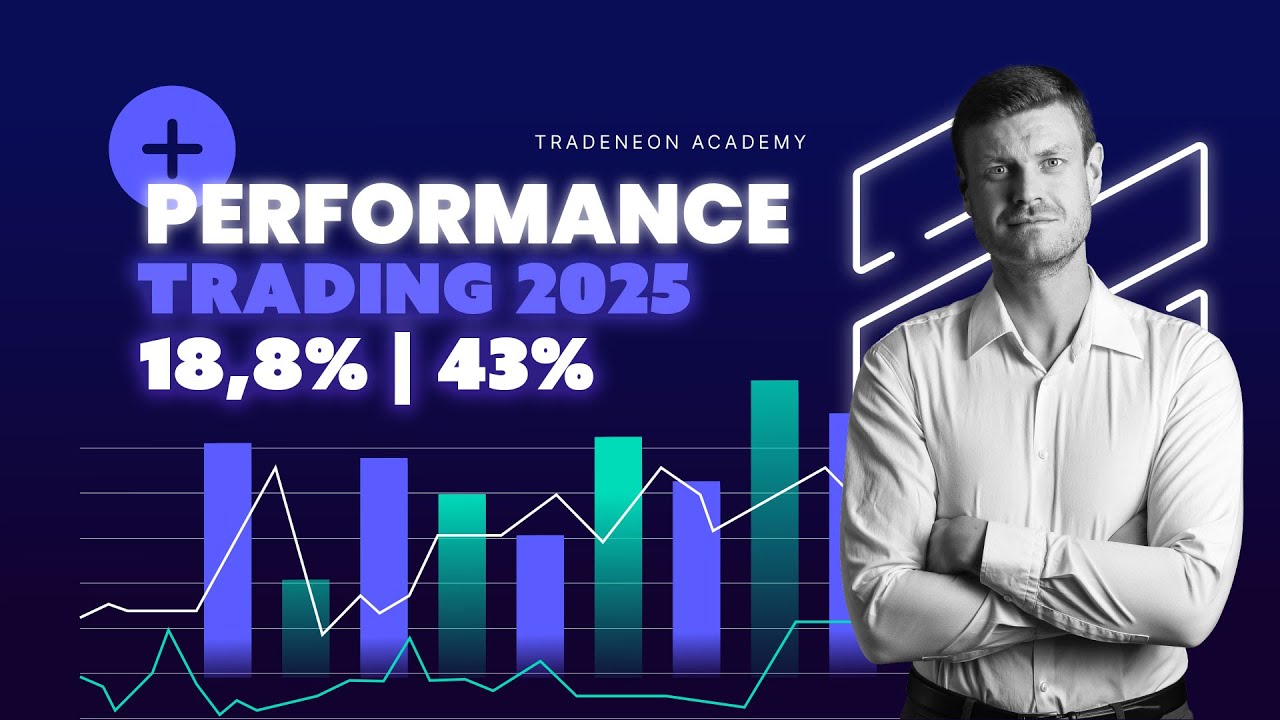
Before we moved everything onto one account in 2026, our trades ran on two: one for swing trading with 10,000 $ and one for day trading and options trading with 30,000 $. We chose both sizes so that most of our clients can relate to them. Both are training accounts, traded the way it works alongside a job – our other private accounts are kept separate.
Swing Trading
+18.8 %Start 10,000 $
Traded with our swing trading systems throughout the year, spread broadly across stocks, currencies and commodities. The clear rise towards the end of the year came largely from two new stock systems we developed in 2025 together with the participants of our swing trading training.
Day Trading & Options Trading
+43.37 %*Start 30,000 $
In day trading, at most one trade a day, each one executed through 0DTE options: a high hit rate, calm trading, the way it can be done alongside a job. The options trading ran on the strategies from our former options training. The strategies are still running today and can now be subscribed to through our Marketplace.
* The split comes from Oliver’s trade log and adds up to 41.53 %. The 43.37 % is the account balance at Interactive Brokers on 30 December – it also includes what is not in the log, such as interest on the cash balance.
The video loads from YouTube when you click. The video is in German; English subtitles can be switched on in the player.
Why we publish our results
Four rules we hold ourselves to
Performance without context is just a number. In our programmes, our clients see live every week how our performance comes about. In swing trading we announce every trade publicly on Discord before we enter it.
No demo accounts. No promise of results. Realistic numbers.
Account sizes you can relate to
We choose account sizes most traders can identify with – not six- or seven-figure showcase accounts that say little about what is actually workable.
Relevant to everyday life
We show performance in a way that makes sense for people with a job – not optimised for maximum screen time or constant market activity.
Focus instead of overtrading
Our approach is deliberately suited to everyday life and workable alongside a career – focused on quality, context and sound decisions.
Transparency in the right context
Our clients see trades live and in context during coaching. In public we publish performance for the sake of transparency – not as a benchmark.

Who is TradeNeon
Our team stands behind this performance
TradeNeon is an education and software company based in Dubai, grown out of the Sparing Investment Academy GmbH in Hamburg. Alongside founders Marnie Aramruck and Oliver Sparing stands a strong team of traders, programmers, analysts and mathematicians.
In an opaque industry, we show our account because we would value exactly that as clients ourselves. Anyone offering an education should disclose what their own rules do over a real year – including the costs and drawdown phases that are an unavoidable part of everyday trading.
Our numbers are not a promise and not a benchmark. Understand trading, structure decisions – that is what we stand for at TradeNeon.

Frequently asked
Seven questions for Oliver
The questions this account keeps prompting – answered by the person who trades it.
Question missing? support@tradeneon.com
Isn't that a lot of trades for an account that runs on the side?
Yes, it is a lot: roughly 1,600 orders in eight months, resulting in about 800 closed positions – four to five on an average trading day. That is precisely the point. The systems are rule-based and the software does the preparation, so volume costs almost no time here. You don't recognise an account that runs on the side by how few trades it makes, but by how little time many trades take.
How much time does this account really take?
This year's performance is heavily weighted towards swing trading. The real time spent per day has rarely exceeded 30 minutes. On days when we also day traded, it took roughly one to two hours.
Is this your only account?
No. It is an account for the education – our private capital, but only part of it. It was opened at a size most people can relate to, and it is traded with exactly the systems discussed in class. We do of course hold further private trading accounts.
How much do you risk per position?
Calculated from the account statement: the typical losing trade came to $75, which is 0.15% of the account. The largest single loss in eight months was $597 – 1.2% of the account. Of 286 losing positions, 271 stayed below 0.5%. An overnight gap can overrun any plan, which is why this page states what came out, not only what was intended. In practice the risk per trade depends on the system: the shorter the time horizon, the less we usually risk.
Why show March at all?
Because a curve without a setback proves nothing. March cost around $3,500 – the worst month of the year. Anyone showing only winning months either has no real-money account or is leaving out half the story.
Why only around $50,000 and not more?
Because a bigger number says nothing about whether something can be done. Six-figure showcase accounts are impressive, but they don't answer the question that matters: what is achievable alongside a job? This figure is here not because it is the maximum, but because it came about under conditions that can be repeated – and at a size most of our clients can relate to.
Would more be possible with more time?
Someone sitting at the screen all day can run more positions – and lose more just as easily. More time and more capital always move both directions. What you see here is not a maximum, but an account under everyday conditions. With more regular day trading, a somewhat stronger result would indeed have been possible.
Where to go from here
The tools this account is traded with
One thing first, plainly: the two programmes behind this account run in German only, in live sessions with German-speaking coaches. If you speak German, both are linked at the bottom of this page.
What is available in English is the software these systems are traded with – the same tools, on your own account.

Futures Insights
The fundamental analysis behind the swing systems: three fundamental data sets condensed into five indicators across 26 markets. It is what simplifies the weekend analysis on this account.
- 26 markets
- CoT data
- Free plan available

Level of Interest
The order flow tool behind the day trading part: dealer positioning and the levels where market makers have to hedge – on four markets, across six platforms.
- 4 markets
- 6 platforms
- ES, NQ and more
German speakers: the swing trading programme and the day trading programme are both twelve months, with weekly live sessions in small groups.
Past results are no guarantee of future performance. Trading involves substantial risk. All content serves general education and does not constitute investment advice.