
The real edge stays human

Democratization in trading through AI: AI can support retail investors with analytical tasks that often required more time and specialist knowledge in the past. Here is what really lies behind it — the genuine advantages for investors and traders, and the dangers you should know.
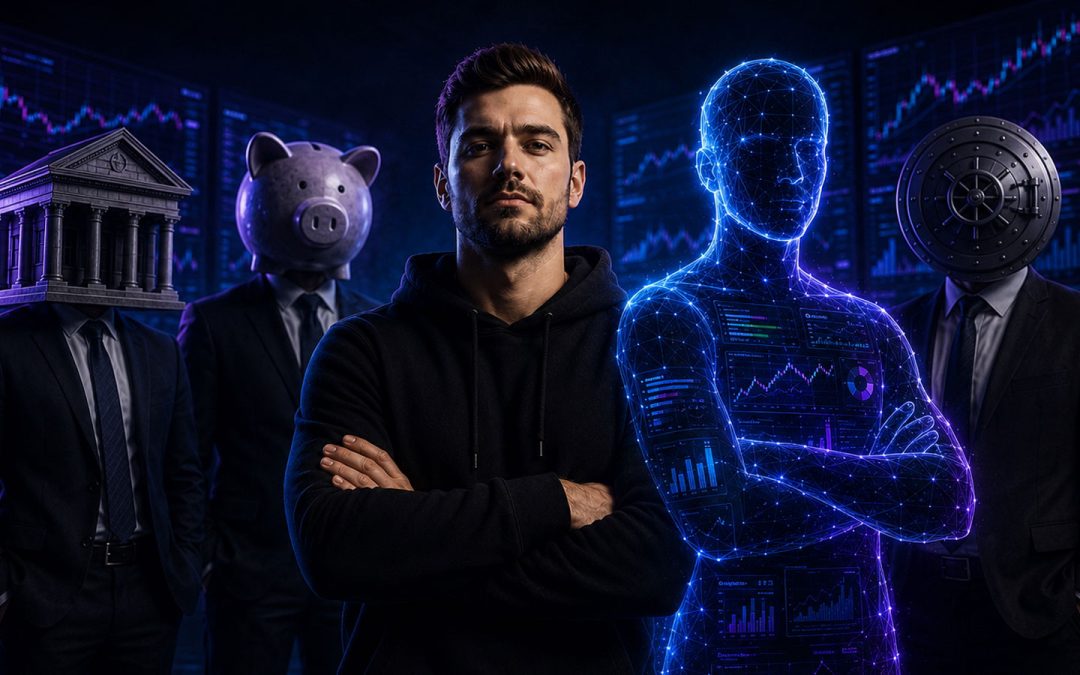
As tools become more accessible, judgment stays human.Image: TradeNeon
barrier to entry.
Few topics are discussed in the markets right now as much as artificial intelligence — and for good reason. AI can now help in the browser with analytical tasks that often required more time, programming skills or specialist support in the past. That does not mean retail investors have the same data, resources or trading opportunities as institutional players. People like to call this the "democratization" of the financial markets.
In this article we look at what really lies behind it. First we clarify what this democratization actually means, and why AI makes analysis so much more practical for private traders and investors today. Then we take an honest look at the dangers and misconceptions that come with the topic — and there are plenty. Finally, we show you with concrete examples what AI offers the investor on one hand, and the trader, or speculator, on the other. Because those, as you will see, are two very different things.
What "democratization" in the financial markets really means
Let's start by looking back. For decades the financial markets carried a massive imbalance. On one side stood the institutional players — banks, funds, hedge fundsInvestment funds with broader latitude to use leverage, short sales and derivatives; often restricted to professional or wealthy investors. — with expensive data terminals, whole teams of analysts and programmers, and computing power that retail investors could only dream of. On the other side sat us, the private traders, often with delayed price data, a gut feeling and maybe the business section of the daily paper.
This gap has never fully disappeared, and we should never claim it has. Lower-cost brokers, accessible real-time data and freely available charting platforms have lowered some barriers to entry. AI can make further analytical tasks easier. How much it helps in a particular case depends on the tool, the data and your checks.
What makes AI so remarkable is not primarily that it can do something no one could do before — much of it was technically possible already. The decisive point is that it can lower the barrier to entry. For example, you can request an initial code draft without programming experience or have reports structured for you. Recognizing errors in statistics, data and code still requires expertise or specialist support. That is what democratization means here: an easier entry into some analytical tasks does not make anyone a professional.
How AI suddenly opens up analysis
Perhaps the most important breakthrough is that natural language has become the new interface. Custom analyses of a dataset often required programming skills, although spreadsheets and other analytical software existed before generative AI. Today you can ask your question in plain German or English and request a structured answer, a table or a code draft. The output needs checking. That changes three things fundamentally:
- Speed. An initial analysis draft can be produced faster with AI. The time saved depends on the task, the data and the corrections needed. Faster does not automatically mean better, but AI can help you investigate more ideas.
- Lower barriers to entry. Programming, statistics, the tedious cleaning of raw data — for years these were the entry tickets to serious market analysis. AI can support parts of this work. Asking the right questions, preparing data and interpreting the results with subject knowledge remain your responsibility.
- Processing large volumes of text. Annual reports, central-bank minutes, earnings calls, news streams — these can be large volumes of text that take time to read in full. AI can summarize and compare texts you supply or that it can access through connected sources, and suggest relevant passages. It may omit or misinterpret important material.
Impressive so far. But this is exactly the point where we need to tap the brakes — because where there is much light, there is also shadow.
Where the dangers and misconceptions lie
At TradeNeon we take seriously our job of pointing out the other side of the coin and giving you a realistic picture of trading and the markets. Precisely because AI is such a powerful tool, the misconceptions around its use are especially critical. We don't want to keep the most important ones from you.
This is a dangerous misconception. Access to a tool alone does not establish a market edge. If many people use the same tool, that may limit a possible advantage; how quickly and to what extent cannot be stated as a general rule. AI can make access easier. Whether your approach produces a robust edge needs independent testing.
AI models can sound convincing and still be completely wrong. They occasionally "hallucinate" figures, sources or connections that simply do not exist. In everyday use that is annoying — in an investment decision it can get genuinely expensive. The iron rule: trust is good, checking is mandatory. Ask for sources and verify the key figures yourself against the original sources. Do not base investment decisions solely on AI-generated information. Source: Investor.gov. You need a clear goal in mind and to know where you want your project to go. AI is no substitute for expertise, and for the layperson it can quickly produce plausible-sounding nonsense.
"Garbage in, garbage out" applies to AI just as it does everywhere else. Ask a sloppy question or feed the model bad data, and you get a bad result — just nicely worded. The quality of your question influences the answer, as do data quality, freshness and the limits of the model. Even a well-phrased question does not prevent errors.
When developing and testing trading systems, the temptation is strong to use AI to keep tweaking parameters until the backtestA historical test of a trading strategy. It shows a hypothetical result, not a future return. curve looks gorgeous. The problem: a system can be fitted so closely to past data that it mainly captures chance patterns and fails on new data. We'll come back to this shortly, because it is so central for traders.
The responsibility stays with you. The generative AI described here is an assistant and does not replace qualified investment advice. It takes work off your hands, but never the decision — and certainly never the risk. Every trading decision is yours to make and to answer for. Not even the most impressive model changes that.
So much for the necessary caution. Now let's look at where AI — used properly — actually makes a real difference. Here we need to draw a clean line, because the value looks quite different for investors than it does for speculators.
AI for investors: fundamentals with your own checks
The investor thinks long term. It is not about the next tick, but about a question: is this company, this sector, this market worth letting my capital work there for years? This is where AI can support research and analysis. The information available depends on the data supplied and the connected sources.
- Understanding annual reports and earnings calls. A single annual report easily runs to hundreds of pages. AI can pull out the key statements, name the risks buried in the fine print, and compare management's language in the earnings call with the previous quarter — if the tone shifts from "optimistic" to "cautious", that can be a reason to examine the original statements and their context more closely.
- Comparing companies across an entire sector. Instead of laboriously digging through a dozen balance sheets, you can have metrics like margins, debt or growth laid out side by side in a structured way, and get an overview of a sector far faster.
- Decoding macro statements. Statements from the Fed and the ECB are often written in an almost diplomatic language whose fine nuances can move billions. AI helps you place these statements in context, compare them with earlier meetings and surface the decisive changes.
- Condensing the news and sentiment picture. From a confusing stream of headlines you can distil a condensed sentiment picture for a stock or a sector — as a starting point for your own, deeper research.
The decisive point: none of this replaces your own judgment, but it can help the retail investor analyze available information more purposefully. The homework stays the same — check the numbers yourself before you commit capital.
AI for traders and speculators: statistics, backtests, systems and indicators
For the active trader it looks different. This is not about the fundamental valuation of a company over years, but about probabilities, recurring patterns and one question: does what I'm doing actually carry a statistical edge? In this world of data, rules and tests, AI is an exceptionally useful ally.
- Pulling statistics from your own data. What is your average hit rate at a particular time of day, really? What does the distribution of your wins and losses actually look like? Where do you make money, and where do you burn it? AI can analyze your own trading data and give you answers that once required you to become an Excel acrobat yourself.
- Preparing backtests with AI. Turning a trading idea into a testable backtest can be a substantial hurdle when programming skills are missing. AI can produce an initial code draft from an idea described in words, allowing you to test it against historical data. You need to check, or have a qualified person check, whether the code implements your rules correctly and models data, costs and execution realistically. The result remains hypothetical. Source on checking code: NIST.
- Developing your own trading systems. From the first vague idea through clearly defined entry and exit rules to well-thought-out risk and position management — AI can accompany you through the entire process as a sparring partner, helping you structure your thoughts and expose gaps in your logic.
- Building your own indicators. You always had an idea for an indicator but didn't know how to put it into Pine Script or Python? AI can lower that hurdle, but the code and data still need checking. From a simple momentumThe observation that prices may continue in an established direction for a time. filter to a more complex statistical indicator, it can help with design and implementation. The work needed for tests and corrections depends on the project.
- Supporting recurring routines with AI. Data pulls, daily evaluations, preparing market data — AI can help prepare scripts for these routines. Check data sources, permissions and results, and retain control over the process. This can free up time for trading and analysis.
Here lies the overfittingFitting a strategy so closely to past data that it captures chance patterns rather than a robust rule. trap mentioned earlier. A backtest provides a hypothetical result under specific assumptions, not evidence of future profits. Distinguish between in-sample data used for development and separate out-of-sample test data. Do not keep adjusting the rules to those test data, or they too lose their value as a check. Be suspicious of systems with too many optimized parameters and ask whether the result could be achieved in real trading: have fees, slippage, data quality and different market conditions been considered? Even a good out-of-sample test does not guarantee a future return. Source on overfitting: Bailey et al.. The gap between a beautiful backtest curve and lived reality in the markets is, in our experience, wider than most people think.
You can see it: while AI mainly helps the investor to understand, it mainly helps the trader to build and test — to develop, test and refine rules whose possible edge still needs to be checked.
AI for investors
Time horizonYears — long term
The questionIs the company worth it?
AI helps withUnderstanding
In practiceReports, macro, sectors, sentiment
Biggest trapTaking hallucinated numbers at face value
AI for traders
Time horizonTick to days — active
The questionDoes this carry a statistical edge?
AI helps withBuilding & testing
In practiceStatistics, backtests, systems, indicators
Biggest trapOverfitting (in- vs. out-of-sample)
The real edge stays human
Amid all the enthusiasm, one thought matters most to us, and it is the one we want to close on: AI can make analytical tools more accessible. Access to reliable data still depends on the sources actually available to you. This does not make success universally available. As similar tools become easier to access, the following question becomes more important.
"It is no longer 'who has the better tools?' but 'who asks the better questions, has the better strategy, and the discipline to execute it?'"
Oliver Sparing — TradeNeonThis is exactly where what we most like to talk about at TradeNeon comes back in: market understanding, risk awareness, structure and personal responsibility. AI makes the toolkit accessible — whether you build something solid from it still depends on you.
AI can make analytical and programming tools more accessible to retail investors. For investors, it can help structure and compare annual reports, sector metrics and central-bank statements. For traders and speculators, it can help produce statistics, prepare backtests, develop systems and build indicators. An initial draft is possible without years of programming training; expert checking, reliable data and risk management remain necessary. Access to tools is not a demonstrated trading edge.
"AI is an amplifier, not a replacement. It doesn't hand you an edge — at best it helps you find your own edge faster and execute it more cleanly."
Oliver Sparing — TradeNeonThose who take these limits into account can use AI to support research and the testing of ideas. For those who don't, there is a real risk of being lulled into false security by nicely worded answers and perfect backtest curves. Use the new possibilities — but stay the critical, self-responsible decision-maker you have to be in the markets anyway.
Glad you are here.
